

21.04.2026
Help others understand health advice and receive a £25 voucher
Between September 2024 and December 2025, 10,119 escalation calls were made to Martha’s Rule helplines.
3,457 of these calls helped identify acute deterioration, which led to 1,885 patients receiving changes in treatment, including 446 potentially life-saving interventions to transfer them to enhanced levels of care.
More than 6,000 calls have addressed clinical, communication, or coordination concerns, leading to meaningful improvements in care or system navigation for patients and their families.
Calls via Martha’s Rule helplines have more than doubled since June last year (4,911) as the roll out has been ramped up, with all adult and paediatric acute inpatient sites in the NHS now in the process of implementing Martha’s Rule.
Hospitals have rolled out communications campaigns, including dedicated posters around their wards and buildings, to help raise awareness of Martha’s Rule and ensure the programme is easy-to-understand and that its use is normalised for patients, families and staff.
Martha’s mum Merope Mills said: “The more data that is gathered, the clearer it becomes that Martha’s Rule is having a hugely positive effect. Apart from the lives saved, over a third of the calls have led to a marked improvement in care.
“The process is not being overused and has obviously met a need, giving patients and families real agency. We look forward to its thorough implementation in maternity departments and call for its rapid introduction in Wales and Scotland.”
Dr Aidan Fowler, National Director of Patient Safety at NHS England, said: “Martha’s Rule is already helping to save lives and transform the culture of the NHS – with 10,000 calls made to the helplines in just over a year and over four hundred potentially life-saving interventions triggered.
“These figures show that Merope and Paul’s tireless campaigning and the hard work of staff are helping the NHS listen to families more effectively and shows that when concerns are raised, hospital teams are ready to respond.”
Martha Mills died in 2021 aged 13 after developing sepsis in hospital, where she had been admitted with a pancreatic injury after falling off her bike.
Martha’s family’s concerns about her deteriorating condition were not responded to, and in 2022 a coroner ruled that Martha would probably have survived had she been moved to intensive care earlier.
In February 2024, NHS England began the implementation of Martha’s Rule, following the campaigning of Martha’s parents, Merope and Paul, and a roll-out across 143 pilot sites was announced in May 2024.
The major patient safety initiative in hospitals requires staff to use a structured approach to obtaining information about a patient’s condition from patients and their families at least daily and encourages patients, families and carers to speak to the care team if they notice changes in someone’s condition.
It also provides them with a way to seek an urgent review if their or their loved one’s condition deteriorates – and are concerned this is not being responded to.
Staff can themselves ask for a review from a different team if they are concerned the appropriate action is not being taken.
The roll-out of Martha’s Rule has been made possible by the dedication of Martha’s parents, Merope and Paul, and the hard work of NHS staff across the country, supported by NHS England and the Health Innovation Network’s Patient Safety Collaboratives.
Waiting times for patients this winter were the shortest in four years as NHS planning paid off for patients. The number of patients attending A&E who were admitted, transferred, or discharged within four hours of arrival at emergency departments was at its highest rate this winter (73.6%) since 2021/22, when it was 73.8%.
While the number of ambulance call-outs this winter were the highest on record, topping 3.2m (3,223,778), figures show almost 130,000 more ambulances handovers at A&E where the handover time was known this winter (1,640,783) compared with two years ago (1,511,758).
Despite high 999 demand, ambulance responded faster to the most serious call outs, including for strokes and heart attacks, than they have for half a decade (2020/21) – with average Cat 2 ambulance waits down to 32:29.
Despite the record winter, the waiting list has continued to fall and decreased to 7.25m in January 2026, dropping by 43,666 compared to the previous month.
This represents an estimated 6.13m unique patients. Overall, the waiting list has decreased by more than 370,000 (374,083) since June 2024.
NHS National Medical Director Professor Meghana Pandit said: “The NHS was ready to tackle winter head on this year, which is why despite facing record-breaking demand, staff have delivered the shortest winter waiting times for four years – while waiting lists have continued to fall.
“This is proof that the NHS is starting to turn a corner for patients – but we know the job is far from done.
“For too long, too many patients have faced the indignity of being treated in hospital corridors. That’s why we’re taking a zero-tolerance approach – with hospital leaders out on the wards and corridors making sure patients are treated with the dignity they deserve.
“I also want to thank the public for their role in supporting the NHS this winter – these figures show the huge impact of the public getting vital winter jabs.”
Health and Social Care Secretary Wes Streeting said: “After years of rising waiting times, patients are finally starting to see things move in the right direction – with waiting lists at their lowest level for almost three years and more people getting treated within 18 weeks.
“Despite record demand this winter, A&E and ambulance services improved – meaning patients are getting help faster when they need it most, thanks to the hard work of NHS staff, better planning and modernisation.
“But we won’t take our foot off the gas. We’ll keep cutting waiting times, backing NHS staff and making sure patients get the high-quality care they deserve.”
Source: https://www.england.nhs.uk/2026/03/nhs-waiting-list-continues-to-fall-despite-record-winter/
Many people develop breathing problems each year that could have been prevented. This No Smoking Day, the NHS is encouraging people who smoke to make use of the free help available across the region.
NHS teams and community stop smoking services offer support that is simple to access and proven to work. People can receive one to one advice from trained advisers. They can also access nicotine replacement products and guidance on using vaping products in a safe way.
These services are available to anyone who wants to quit. They support people who are trying to stop for the first time as well as those who have tried before and want to try again.

Stopping smoking is one of the most effective ways to protect lung health. This is especially important for people with asthma, COPD or chronic bronchitis. Cold weather and winter illnesses can make symptoms worse. Quitting smoking helps the lungs recover and makes it easier to stay well through the winter months.
Many people feel unsure about stopping or worry that they have smoked for too long to see any benefit. However, evidence shows that quitting brings quick improvements at any age. Breathing can become easier in a short period of time. Coughing often reduces and many people feel more energetic.
Local stop smoking services across the North East and North Cumbria have already helped thousands of people to quit. These services offer a range of options that include phone appointments, group support and personalised plans. Regular encouragement can make a big difference and help people stay on track.
This No Smoking Day, the NHS is reminding people that they do not need to stop smoking on their own. Asking for help is an important first step and can have a positive impact on long term health.
A new episode of the Frontline Voices podcast features regional tobacco experts Rachel McIlvenna and Dr Ruth Sharrock. They discuss how smoking affects the body and explain how people can access support in their local area. Watch it here.
For more information on services to help you quit smoking visit: https://www.nhs.uk/live-well/quit-smoking/nhs-stop-smoking-services-help-you-quit/
Photo: South Tyneside and Sunderland NHS Foundation Trust’s Tobacco Dependency Treatment Team celebrating three years of supporting patients to live smoke‑free
This joint report brings all of that insight together, showing what’s working well, where people are still struggling, and what would make accessing GP care clearer and fairer.
The Integrated Care Board (ICB) has now taken this work forward. Our findings have been commended by the Quality & Safety Committee, will feature in GP bulletins and are being used to inform planning through the March Primary Care Sub‑Committee.
Thank you to everyone who spoke to us. Your voice is already influencing change across primary care.
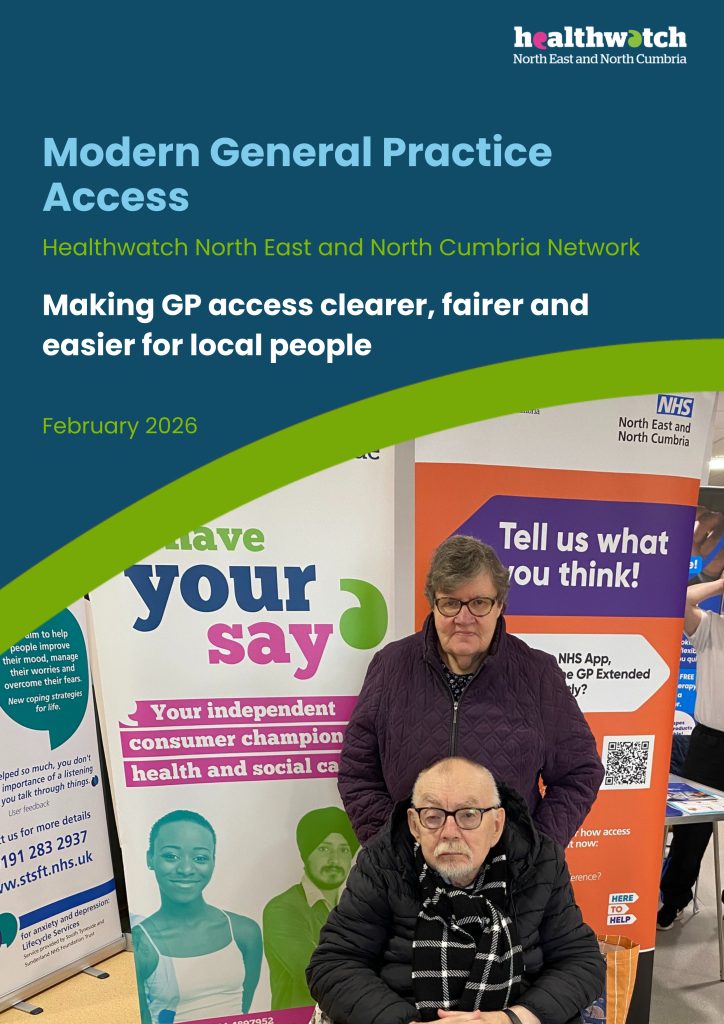
Download the report by clicking on the image below…
The survey of patients across England found that 12 per cent said they had forgotten about an appointment in the past, and 11 per cent had arrived too late.
The latest appointment statistics also show that patients did not attend 16m GP appointments in 2025, with no shows for one in 23 appointments (4.3%) – the equivalent of an entire day of missed appointments at every GP practice in England each month.
The figures also reveal that the NHS arranged 376m appointments at GP practices in 2025 – 8.4m more (2.3%) than in 2024.
The new ‘Tap the NHS App’ campaign is highlighting the benefits of enabling notifications, with adverts appearing on pharmacy bags, radio channels and social media.
Users are also being encouraged to cancel or rearrange their appointments through the app and to use it to request repeat prescriptions instead of having to visit their GP practice.
Last year, the NHS rolled out a new Amazon-style prescription tracking feature in the NHS App which updates users on the progress of their prescription and when it is ready to be collected. It is currently available at 2,000 pharmacies across England.
Dr Amanda Doyle, National Director for Primary Care and Community Services at NHS England, said: “People will often have genuine reasons for not being able to make an appointment or arriving too late, but it’s really important that they let us know if possible so we can offer the appointment to someone else.
“One of the easiest ways you can reduce the risk of missing an appointment is by tapping the NHS App to turn on notifications to get reminders, so you can cancel or rearrange them if they need to.
“It’s fantastic to see that GPs provided more than 8 million extra appointments for their patients in 2025, and I hope this new campaign will help increase that number even more in 2026.
“I’d encourage all NHS App users to make the most of what the app has to offer so they never forget an appointment.”
Dr Zubir Ahmed, Health Innovation Minister, said: “In the busy lives we all lead, it can be easy to forget an NHS appointment or need to reorganise it at the last minute.
“That’s why I’d encourage everyone to tap the NHS App and turn on notifications – so you can stay on top of your appointments and let us know if you need to reschedule.
“When you do, someone else can be seen instead, helping us continue to cut waiting times.”
Latest ONS figures show that people are increasingly preferring to contact their GP online when they have a health problem.
Three-quarters (75.2 per cent) of adults found it easy to contact their GP practice, up from 71.6 per cent a year ago.
The NHS App has over 40m registered users, who are able to view their GP health record, order repeat prescriptions and access a range of NHS services to manage their own care.
Users can go to the settings section in the NHS App to enable notifications and update their contact details to make sure they receive important messages about their healthcare.
The survey on NHS appointments was of 2,000 people in England aged 16 or over, carried out by Censuswide on behalf of NHS England.
The contract also includes a new requirement that all patients who are deemed clinically urgent by their GP practice must be dealt with on the same day and appointments will be required to take place that day in 90 per cent of cases.
As trailed over the weekend, the contract also strengthens the role of general practice in prevention and neighbourhood health services, including targeted action to improve childhood vaccination uptake, ensuring all those eligible are invited for lung cancer screening through improved data sharing, enabling earlier cancer diagnosis; and a £25m investment to increase referrals into structured weight‑management and obesity support services.
Responding to the publication of the new GP contract, Dr Duncan Gooch, GP and chair of the Primary Care Network at the NHS Confederation said: “We are grateful to the Department of Health and Social Care and NHS England for involving the NHS Confederation in the consultation exercise to enable us to put across the views of our primary care members.
“We welcome the additional investment in primary care and the clear intent to stabilise core general practice through funding and streamlining unnecessary workload. After years of sustained pressure, these commitments are both necessary and overdue.
“Primary Care Networks and GP federations may be concerned to see a continued erosion of funding for at-scale provision to improve access and patient experience. Strong, at-scale infrastructure is not a ‘nice-to-have’, it is absolutely essential now and for the future if neighbourhood health services are to be delivered effectively, sustainably and equitably.”
Healthwatch England Deputy Chief Executive Chris McCann added: “The new contract will be welcome news for people who have struggled to access GP services. Plans to recruit more doctors should make it easier for patients to get appointments and ensure urgent cases are handled more quickly.
“People consistently tell us that GP services are becoming harder to use and that simply getting through the door for care can be a challenge. For example, we often hear from individuals who wait in long telephone queues for an appointment, only to be told that all slots have been taken for the day and that they must try again tomorrow.
“We also hope the changes to the contract will reduce the technological barriers people face when trying to access GP care, such as online booking systems being unavailable or switched off.
“Thanks to the experiences shared by the public, we were able to support the government in highlighting the public’s top priorities so it could develop a new GP contract that better meets patients’ needs. Their feedback enabled us to highlight the importance of clarity, fairness, and accessibility, and to ensure that people with complex needs, low digital confidence, or limited options are not left facing additional barriers to care.”
Sources:
https://www.nhsconfed.org/articles/health-care-sector-latest-developments
https://www.healthwatch.co.uk/response/2026-02-24/our-response-new-gp-contract
Latest news
21.04.2026
Help others understand health advice and receive a £25 voucher
20.04.2026
Tell us about your experience of hospital discharge
16.04.2026
Athletics legend Steve Cram inspires NHS staff to get active

08.04.2026
Bereaved families invited to take part in new research study

08.04.2026
New mental health support service for LGBTQ+ young people aged 11–25

07.04.2026
Young people waiting up to two years for mental health support
Quick online NHS services

Have your say
Let us know about your recent experience of health and social care services.
Let us know