

21.04.2026
Help others understand health advice and receive a £25 voucher
This advice is about the flu vaccine for adults. There are also pages about the children’s flu vaccine and flu jab in pregnancy.
The flu vaccine is recommended for people at higher risk of getting seriously ill from flu. It’s offered on the NHS every year in autumn or early winter.
You can get the free NHS flu vaccine if you:
Frontline health and social care workers can also get a flu vaccine through their employer.
The flu vaccine is recommended for people with certain long-term health conditions, including:
Most eligible adults will be able to get the flu vaccine from Thursday October 3rd. This may be later than you’ve had the vaccine before, but it means you’ll have the best protection when flu is most widespread.
Some people may have their vaccination from September, including if:
Speak to your GP for advice if you think you need to have the vaccine earlier than October.
If you’re eligible, you may be able to get a flu vaccine from:
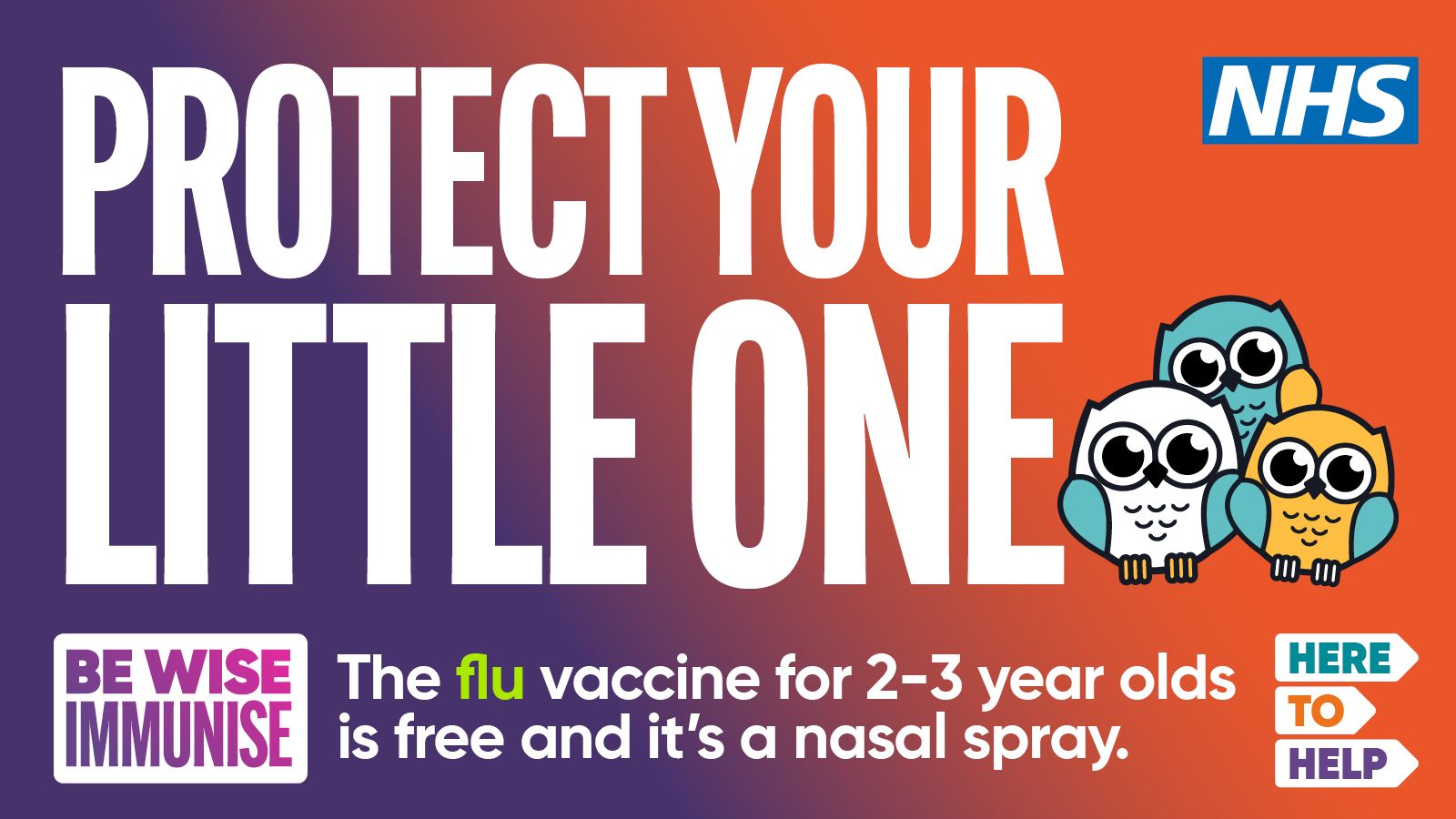
Frontline health and social care workers will usually get the flu vaccine through their employer.
If you cannot get a flu vaccine through your employer, you can get it at a pharmacy or your GP surgery if you’re employed:
If you’re aged 18 or over, you can book a flu vaccination appointment at a pharmacy online or in the NHS App now.
You need to book your vaccination before December 20.
You can have the flu vaccine at the same time as other vaccines such as the COVID-19 and shingles vaccines.
It’s not usually given at the same time as the RSV vaccine, but you can have them at the same time if a doctor or nurse thinks it’s needed.
Most people who are eligible for the flu vaccine can have it.
You only cannot have the vaccine if you’ve had a serious allergic reaction (anaphylaxis) to a previous dose of the vaccine or an ingredient in the vaccine.
Some of the flu vaccines used in the UK contain egg protein. Tell the person vaccinating you if you have an egg allergy.
If you have a high temperature, wait until you’re feeling better before having your flu vaccine.
There are several types of flu vaccine given in the UK. If you’re eligible for the flu vaccine on the NHS, you’ll be offered one of the types that’s most appropriate for you.
You can check the ingredients in the patient leaflets here.
The most common side effects of the flu vaccine are mild and get better within one to two days.
They can include:
More serious side effects such as a severe allergic reaction (anaphylaxis) are very rare. The person who vaccinates you will be trained to deal with allergic reactions and treat them immediately.
The injected flu vaccines used in the UK do not contain live flu viruses. They cannot give you flu.
Find out more about why vaccinations are important and the safest way to protect yourself
The flu vaccine aims to protect you against the most common types of flu viruses.
There’s still a chance you might get flu after getting vaccinated, but it’s likely to be milder and not last as long. The vaccine usually takes up to 14 days to work.
Protection from the flu vaccine goes down with time and the types of flu virus the vaccine protects against are updated each year. This is why it’s important to get the flu vaccine every year.
Source: https://www.nhs.uk/vaccinations/flu-vaccine/
That’s why it’s important to check your eyesight regularly and, if there is a problem, be able to access the support you need.
However, many people are facing long waits and high costs for eye care.
Some groups of people, such as certain ethnic minority communities and those on lower incomes are also more likely to experience poor eye health and have poor experiences of eye care services.
As part of the #ShareForBetterCare campaign, we want to know about your experiences of eye care. We want to know:
Your views are vital to helping improve eye health and other NHS services in your area. It helps local NHS managers understand what is working and what they need to fix.
This National Eye Health Week (Sept 23 to 29) Healthwatch is asking people to complete a short online survey which aims to understand people’s experience of accessing eye care locally, as well as the experience of those waiting for secondary care. We also want to uncover what is working but also the barriers people face, like cost.
The survey, which can be accessed via the link below, closes this Sunday September 29:
https://bit.ly/eye-care-survey
[1] https://fingertips.phe.org.uk/profile/vision
[2] https://www.england.nhs.uk/statistics/statistical-work-areas/rtt-waiting-times/rtt-data-2024-25/
[3] https://media.rnib.org.uk/documents/Circumstances_sight_loss_report.pdf
[4] https://www.rnib.org.uk/professionals/health-social-care-education-professionals/knowledge-and-research-hub/key-information-and-statistics-on-sight-loss-in-the-uk/
Under the deal – which the Health Secretary agreed with BMA leadership within three weeks of coming into office – the government and junior doctors will work together to turn the health service around and resolve wider issues affecting the workforce, including training and rotational placements.
As Lord Ara Darzi set out in his probe into the NHS, this government inherited a broken NHS which is in a critical condition. This is a sentiment shared by doctors, and has been seriously compounded by the impact of strikes.
The deal comes days after the Prime Minister delivered a major speech on NHS reform, saying the government has a profound responsibility to do the hard work required to fix the NHS with long-term reform, and the NHS workforce will play an integral part in both designing and delivering the government’s 10-year health plan to deliver the necessary reform.
The price of not settling the pay dispute has seen catastrophic impacts not just on the country’s economy – with NHS strikes costing the taxpayer almost £1.7bn since April last year – but to patients and the nation’s health, with over 1.5m appointments cancelled. Ending this chaos is a necessary first step in turning around the NHS.
Doctors can now focus on treating their patients, and work with the government to recover and reform the NHS. The government has already taken action to remove red tape preventing general practices from hiring doctors – ensuring more than 1,000 newly qualified GPs can be recruited by the end of the year.
NHS patients will have earlier access to new treatments and the UK will become the home of cutting-edge health research after the launch of the Voluntary Scheme for Branded Medicine Pricing, Access and Growth (VPAG) Investment Programme last month – a joint public-private investment programme worth up to £400m.
The Darzi report has also been welcomed by NHS England and health organisations who have pledged to work closely with the government on its mission to rebuild the NHS.
The Health and Social Care Secretary made reaching a deal his top priority on coming into office, and first spoke with the BMA’s junior doctors committee on his first day, ahead of the offer being agreed within weeks.
Health and Social Care Secretary Wes Streeting said: ”We inherited a broken NHS, the most devastating dispute in the health service’s history, and negotiations hadn’t taken place with the previous ministers since March.
“Things should never have been allowed to get this bad. That’s why I made ending the strikes a priority, and we negotiated an end to them in just three weeks.
“I am pleased that our offer has been accepted, ending the strikes ahead of looming winter pressures on the NHS.
“This marks the necessary first step in our mission to cut waiting lists, reform the broken health service, and make it fit for the future.”
The cumulative impact of the uplifts mean a doctor starting foundation training in the NHS will see their basic pay increase to £36,600, compared to around £32,400 before the deal.
Recognising how disruptive the system of rotations can be for junior doctors, their partners and families, the department will lead a review of the current system, with the intention of reforming the number and frequency of rotations.
We will also be working with NHS England on a review of training numbers, both to address the training bottlenecks which already exist and the planned expansion of medical school places, to ensure patients have access to the junior doctors they need today, and the consultants and GPs they will need in the future.
Source: https://www.gov.uk/government/news/junior-doctors-accept-government-pay-deal
The BMA’s junior doctors committee (JDC) in England has accepted the Government’s pay offer, with 66% of junior doctors voting in favour of the deal.
Junior doctors have been in dispute over more than a decade of real-terms pay cuts since October 2022, during which time they have taken 44 days of strike action.
The pay uplift across these two years of the dispute will be 22.3% on average. This is made up of an additional average 4.05% for the pay year 2023/24 on top of the previously awarded average 8.8%, taking last year’s pay uplift to an average of 13.2% – this will be backdated to April 2023.
The rest of the uplift comes from the recommended pay award for 2024/25 announced in July, which gave junior doctors an average 8% increase across grades. Doctors remain 20.8% behind in real terms compared to a doctor in 2008.
The Government has also committed to work with the BMA to streamline the way in which junior doctors report additional hours they work, to ensure they are paid for the work they do.
There is also agreement to reform the current system of rotational training for junior doctors as well as reviewing the training bottlenecks that previous Governments have imposed, which has manufactured the shortage of consultant and GP doctors.
The junior doctors committee co-chairs, Dr Robert Laurenson and Dr Vivek Trivedi, said: “It should never have taken so long to get here, but we have shown what can be accomplished with our determination and with a government willing to simply sit down and talk realistically about a path to pay restoration. One strike was one strike too many.
“This deal marks the end of 15 years of pay erosion with the beginning of two years of modest above inflation pay rises. There is still a long way to go, with doctors remaining 20.8% in real terms behind where we were in 2008.
“Mr Streeting has acknowledged our pay has fallen behind and has talked about a journey to pay restoration. He believes the independent pay review body is the right vehicle for this, and if he is right then no doctor need strike over pay in future. However, in the event the pay review body disappoints, he needs to be prepared for the consequences.
“The resident doctors committee, as we will be called, will be using the next months to prepare to build on their success so that future cohorts of doctors never again need to see the kind of pay cuts we have. We thank all doctors who have seen us through to this point by standing on picket lines and fighting for their worth. The campaign is not over, but we, and they, can be proud of how far we have come.”
Outside the pay negotiations, the Government has agreed that from 18th September “junior doctors” across the UK will be known as “resident doctors” to better reflect their expertise. This follows a motion to the BMA’s annual policy making conference in 2023 when doctors voted in favour of a name change.
45,830 junior doctors in England took part in an online referendum between 19 August and 15 September, a turnout of 69%. 30,227 (66%) voted in favour of the offer. 15,596 (34%) voted against.
Details of the offer are available here.
The BMA is a professional association and trade union representing and negotiating on behalf of all doctors in the UK. A leading voice advocating for outstanding health care and a healthy population. An association providing members with excellent individual services and support throughout their lives.
Source: https://www.bma.org.uk/bma-media-centre/junior-doctors-in-england-vote-to-accept-pay-offer
Support can include:
 Young people must agree to being referred, but when a young person is under 18, it is helpful when they agree for their parent/guardian to be involved. However, the LGBT+ North East Service team understand this is not always possible.
In these situations, they can work with young people aged 16+ without their parent/guardian being involved and with those aged under 16 without their parent/guardian being involved when they are Gillick competent. This means practitioners have decided that a child is mature enough to make decisions about things that affect them.
More information about the service can be found at humankindcharity.org.uk/service/lgbt-north-east or on their Facebook page. There is also a short film here featuring service users:
From life-threatening emergencies to general health advice, NEAS plays a key role in the North East healthcare system.
Healthwatch is working with the North East Ambulance Service to understand people’s experiences and expectations of the broad range of NEAS’s services, including:
Whether it was sending an ambulance for transport to the hospital, referral to other places for treatment, or treatment at home, we would like to hear your views and feedback in this quick, anonymous survey.
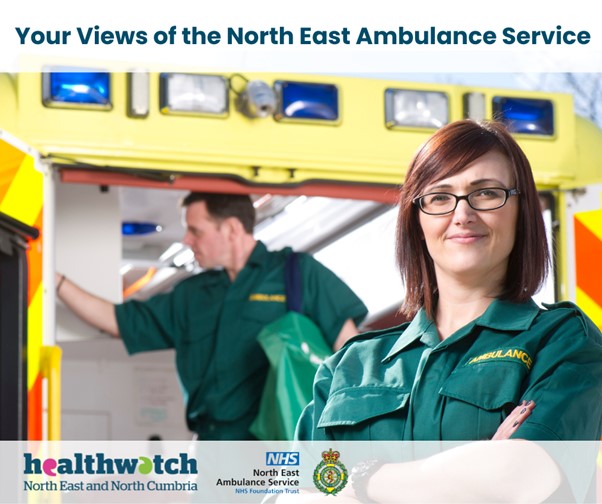
By managing both urgent and non-urgent care, NEAS are at the heart of the health and care system in our region. Your views on how they deliver their services and how they support those who contact them will help shape future planning and delivery.
“Our patients, the people who support them, and people who may need to use our services in the future are incredibly important to us, and we would like them to be at the heart of the way in which we plan our future as an organisation.” (NEAS)

We are interested in your views, whether you have contacted NEAS recently or not. And as a thank you for your time and contribution, at the end of the survey you will have the opportunity to take part in our prize draw to win £100 of Love2Shop vouchers.
If you would be interested in giving more detailed feedback, require a paper copy, or would prefer to talk to someone rather than fill in a survey, please contact us by email at info@hwnt.co.uk or call 0191 263 5321.
He pledged to spend a greater proportion of the NHS budget on GPs, social care and “community services” than on hospitals, which he said would help alleviate pressure on the service overall.
But the Conservatives said the government needed to turn “rhetoric to action” after scrapping its plans to reform social care and build new hospitals.
The report was the result of a nine-week review by the independent peer and NHS surgeon Lord Darzi.
He was asked by Labour, shortly after the election, to identify the failings in the health service, but his remit did not stretch to coming up with solutions.
His findings present a stark picture of a service which he says is in a “critical condition” and “serious trouble”.
The report from the peer, a surgeon who served as health minister in the last Labour government, said the NHS was still struggling with the aftershocks of the pandemic and falling well short of its key targets for cancer, Accident & Emergency (A&E) and hospital treatment.
It said this was contributing to poor survival rates in cancer and heart disease, and falling rates of satisfaction.
The report said the NHS had been left chronically weakened by the policy of austerity of the 2010s and in particular a lack of investment in buildings and technology. This has left it with crumbling hospitals, fewer scanners than many other developed nations and years behind the private sector in terms of digital innovation.
This has contributed to falling levels of productivity in hospitals, with rises in staff not matched by increases in the numbers of patients being seen.
It has meant hospitals have been sucking up an ever-increasing amount of the budget, when more care should be shifted into the community.
Lord Darzi was also critical of the “disastrous” 2012 reforms introduced by the coalition government, which led to a shake-up of management structure in the NHS and acted as a distraction for the rest of the decade.

It said all this contributed to the NHS entering the pandemic in a depleted state, leading to the cancellation of more hospital treatments than any comparable country and the “ballooning” waiting list, which currently stands at 7.6 million.
Meanwhile, a surge in patients suffering several long-term illnesses, such as diabetes, high blood pressure and respiratory illness, is threatening to overwhelm the NHS alongside soaring levels of mental health problems among young people.
The report says:
A&E is in an “awful state” – with long waits likely to be causing an additional 14,000 more deaths a year, according to the Royal College of Emergency Medicine
the state of the NHS is not entirely due to what has happened within the health service, but also because the health of the nation has deteriorated – for example bringing a surge in long-term mental health conditions
rising levels of illness are risking economic prosperity, with 2.8 million people unable to work because of poor health
the UK has higher cancer mortality rates than other countries
although hospital staff numbers have increased since the pandemic, the number of appointments and procedures hasn’t because “patients no longer flow through hospitals as they should”
the NHS has been starved of capital investment, meaning “crumbling buildings”, mental health patients in “Victoria-era cells infested with vermin” and “parts of the NHS operating in decrepit portacabins”
Lord Darzi said: “Although I have worked in the NHS for more than 30 years, I have been shocked by what I have found during this investigation – not just in the health service, but in the state of the nation’s health.”
Although the report focused on the NHS, Lord Darzi also warned of the “dire” state of social care, which he said was not “valued or resourced sufficiently”.
The growing gap between people’s needs and availability of publicly-funded social care in England was placing “an increasingly large burden on families and on the NHS”, he said.
In a speech this morning Prime Minister Sir Keir Starmer responded to the report by promising “the biggest reimagining of the NHS” since it was formed, with a new 10-year plan for the health service to be published in the coming months.
He proposed three key areas of reform: the transition to a digital NHS, moving more care from hospitals to communities and focusing efforts on prevention over sickness.
Sir Keir said Lord Darzi’s report was a “raw and honest assessment” of the NHS. Nearly a tenth of all patients wait 12 hours or more, leading to thousands of avoidable deaths, he said.
“It’s devastating, heart-breaking, infuriating,” the PM added.
Speaking to BBC Breakfast, Mr Streeting added that primary care and community services would be “the first port of call” for new money – not hospitals.
“Rather than a country with an NHS, we’re going to have an NHS with a country attached to it if we’re not careful, and more likely an NHS that goes bust,” the health secretary said.
Streeting also pledged to deliver “schemes” from the previous government’s New Hospitals Programme – but said it may be over a longer timeframe.

Matthew Taylor, the head of the NHS Confederation, which speaks on behalf of NHS organisations and their 1.5 million employees, told the same programme the report had identified some of the problems facing the health service.
But he warned that waiting lists would probably get even longer this winter – as normally happens.
“It will take at least a full term for Labour to get anywhere near the kinds of targets they’ve got for waiting lists”, he said.
Thea Stein, chief executive of the Nuffield Trust think tank, said while Lord Darzi’s report was “not surprising” it was still “deeply troubling”.
“The big question now is what happens next.”
Healthwatch England’s Head of Policy William Pett said: “People will welcome Lord Darzi’s prognosis on the NHS. Although the NHS does much good, patients repeatedly share their frustrations and confusion about accessing care.
“GP access is difficult, NHS dentistry is in disarray, and people face excessive waiting times for hospital treatment. These challenges are not experienced equally, with poorer communities hit hardest. Restoring public confidence in the NHS and delivering timely, safe and quality care must focus on the issues that matter most to people now and in the future.
“We’re calling for improvements to patient communications and administration, giving people a choice of how to access care, a better listening culture within the NHS, and for services to be measured against the quality of patient experiences, not just the length of time they wait for care.
“The public will welcome the chance to help shape the future of healthcare and reset the contract between them and the NHS. Especially if it results in clearer rights, more responsive services and an equal say in their care.”
Sources:
Latest news
21.04.2026
Help others understand health advice and receive a £25 voucher
20.04.2026
Tell us about your experience of hospital discharge
16.04.2026
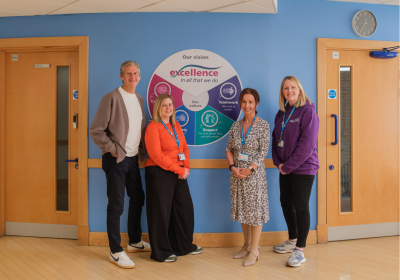
Athletics legend Steve Cram inspires NHS staff to get active

08.04.2026
Bereaved families invited to take part in new research study

08.04.2026
New mental health support service for LGBTQ+ young people aged 11–25

07.04.2026
Young people waiting up to two years for mental health support
Quick online NHS services

Have your say
Let us know about your recent experience of health and social care services.
Let us know