

21.04.2026
Help others understand health advice and receive a £25 voucher
One of the key areas highlighted is the need to improve communication, both between providers and from providers to patients.
This particularly applies to hospital discharge, where HWST suggested hospital-based social workers could improve discharge processes to help enable a shift towards community-based care.
Adult social care and health care services need to collaborate more effectively, with a multidisciplinary approach taken for the provision of care for those with complex needs, dependencies or the homeless, the submission said.
The need to retain traditional models of access and care alongside digital methods and involving patients in the design of new technological solutions was also suggested, with all communication to be in a preferred format that can be understood by the recipient.
To further assist understanding, HWST is recommending built-in patient education (tutorials, how-to guides, digital community champions) with any new digital healthcare rollouts, and funded, accessible community courses or training for those with low digital literacy.
Funding is another key area singled out in the HWST submission, specifically the call for adequate funding and support for outreach and community groups (including warm spaces) and increased support for unpaid carers.
Reform of the welfare benefits system to ensure that adequate and fair allowances are provided to help people look after their family, friends and community is also requested.
Funding should also be provided for GP ‘ward rounds’ in care homes, services that combat loneliness and help people engage with their community and to ensure that elderly people are warm in their homes.
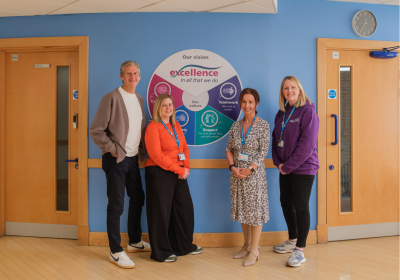
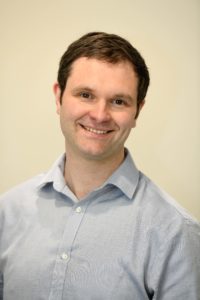 John Lowther, Chair of Healthwatch South Tyneside (pictured), said: “Healthwatch is in an ideal position to recommend improvements to health and social care services, as our findings are based on many years of patient feedback and discussions with providers and their staff.
“We hope our submission assists future decision-making when the Government reviews the Change NHS consultation in developing the 10 Year Health Plan for England.”
The full submission can be downloaded here.
And even if this goal was reached, it would still be 2.6m fewer treatments per year than pre-pandemic levels, the NAO said.
Additionally, an investigation carried out by the British Dental Association and Daily Mirror suggests 96% of dental practices are not accepting new NHS adult patients and at least one in 10 constituencies in England do not have a single practice taking people on.
The dental recovery plan was published in February 2024 under the previous government and aims to increase access to NHS dentistry services. The £200m plan was intended to deliver more than 1.5m additional NHS dentistry treatments (or 2.5m appointments) in 2024-25 and has three components.
The additional courses of treatment in 2024-25 were intended to come from the first of these components, through four headline initiatives:
The NAO report sets out information on the current delivery of NHS dentistry services and the development and progress of the plan for 2024-25. It looks at:
The NAO said: “The dental recovery plan aspires to deliver more than an additional 1.5m courses of treatment in 2024-25 but is not currently on course to do so.
“Even if these additional courses of treatment are delivered by the end of 2024-25, the plan would still mean that 2.6m fewer courses of treatment would have been delivered than in 2018-19.”
Healthwatch England Chief Executive Louise Ansari said: “These findings underline the deplorable state of NHS dentistry. The difficulty of getting NHS dental treatment is one of the public’s biggest concerns about the healthcare system generally and is a crisis that dental leaders have estimated is denying 13m people access to NHS appointments.”
NAO Report Director Lee Summerfield summarises the findings in this short video:
Source: https://www.nao.org.uk/reports/investigation-into-the-nhs-dental-recovery-plan/
North East & North Cumbria Integrated Care Board (NENC ICB) asked Healthwatch through its work on the Living Well Alliance framework to gather insights into the mental health care experiences of older people.
NENC ICB specifically wanted to know if older people felt they experienced ageist attitudes and assumptions about their mental health which led to them being excluded from services and support that could help them to enjoy a healthier and happier later life.
Between May and September 2024, our engagement team spoke to 123 patients aged 65+ in 12 healthcare settings, asking them the following question provided by NENC ICB: “When you meet professionals in health and social care, do they ask about your mental health?”
Our key findings included:
Of the participants, 66% were female, and 99% were white British. Through our conversations across various groups, there were several clear themes.
Participants highlighted that time constraints during doctor’s appointments often discouraged them from seeking help for their mental health. One said: “You are told that you only have so long with the GP, they don’t have the time, and I wouldn’t ask for two separate things.”
Many expressed that using e-consult services can be particularly challenging. A significant number of participants said they do not own a mobile phone or use a computer, making technology a barrier for some.
Throughout discussions the word stigma was used, although participants acknowledged that mental health is more widely discussed today. One said: “It’s embarrassing to talk about your mental health, I would like them to initiate the conversation.”
Participants told us that re-phrasing the term ‘mental health’ would go some way to removing the stigma attached.
Perceptions identified within several groups were that as you get older the doctors “don’t care”, and many health issues are put down to your age. One participant described the experience of talking to a doctor as feeling like “talking to a brick wall”, citing a lack of eye contact as doctors focus on their computers.
Many expressed frustration at rarely seeing the same doctor twice, believing this harms the doctor-patient relationship.
We also received positive feedback, with a number of participants noting that younger doctors are seen as more attuned to mental health issues.
Many respondents acknowledged that their physical health affects their mental well-being. Several emphasised the importance of self-care, highlighting the value of regular check-ups, such as annual MOTs or well-women clinics, in taking personal responsibility for their health.
Participants shared various strategies for supporting their mental health, including healthy eating, regular exercise, and combating social isolation by joining local voluntary groups to build friendships.
One said: “I attend a Happy at Home group, it gets me out of the house and some members of the group come and visit me at home, so I don’t feel lonely or isolated.”
Responding to our findings, the NENC ICB said: “The insights within the report will be utilised to shape how we transform services to ensure that our older residents receive holistic equitable care.
“Furthermore, we intend on developing an age-friendly health system with special features, structure, and functions to meet the special needs of older people and improving their health status and quality of life.
“We will continue to work collaboratively with Healthwatch to ensure that the findings of the engagement inform the next phase of addressing these important issues.”
Healthwatch would like to thank NENC ICB and all participants for their help in this research.
She dialled 999 and an ambulance rushed the 64-year-old to Sunderland Royal Hospital.
There, he was given medicine to get rid of blood clots on his brain, which is known as thrombolysis.
A stroke is when blood stops flowing to part of the brain. It affects speech and movement and needs urgent medical help in hospital because it can be life-threatening.
Following tests and scans, Martin was taken to the RVI in Newcastle in case he needed surgery. Thankfully, the team there found the drug treatment had worked and he was transferred back to Sunderland to recuperate.
After a night on E58, the hospital’s acute stroke ward, Martin was well enough to be discharged.
It meant he was able to make the marriage ceremony of his daughter Emily and her now husband Scott Phinn.
Emily, 27, works as an early learning practitioner, while Scott, 29, is a retail manager in the motor industry. They exchanged vows at Shotton Grange, in Seaton Burn, on Thursday, October 31.
Martin, who was born in Sunderland Royal Hospital and is originally from Whitburn, retired two years ago after 35 years of working off-shore.
He has shared his experiences after contacting South Tyneside and Sunderland NHS Foundation Trust (STSFT) with a note of thanks to the team who treated him. He also sent on photos to share of his family’s special day.
The North East Ambulance Service (NEAS), which helped get Martin the swift hospital care he needed, has also stressed how vital it is to act and get treatment quickly.
In his message to those who cared for him, he said: “The staff were amazing and this was so reassuring for me, as my daughter got married the next day.
“I never thought it was something that I may miss out on. Because of your team’s dedication, I was able to walk my daughter down the aisle, just a day after having my stroke.
“The day was amazing, so thank you all, you worked miracles for me.”
Martin, a keen photographer and videographer, managed to film the day’s events, while Hope Visual Productions captured the moment Martin was able to walk Emily down the aisle.
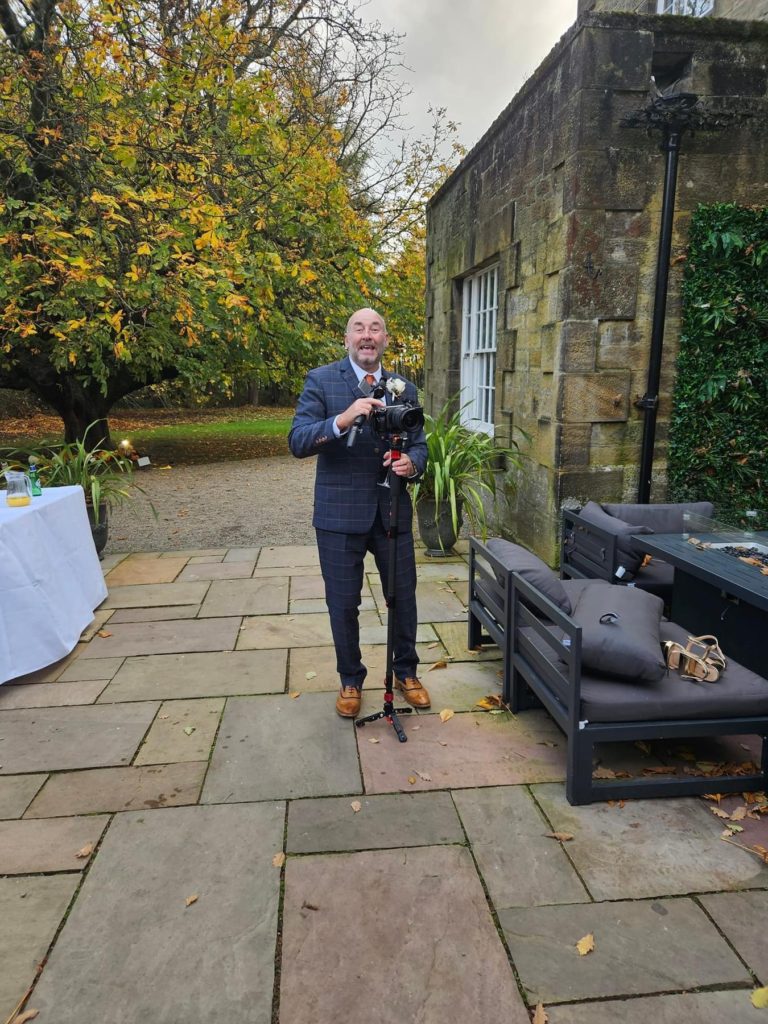
Martin said: “I was at home when the stroke began, after just finishing my usual morning press ups. I was totally unaware anything was wrong and thought my wife was massively overreacting by calling 999 for an ambulance.
“We had a very busy day ahead, as I had a mountain of video camera equipment to set up for the big day and thought I was fine. My wife however, noticed all the tell-tale signs straight away, and despite assurances from me that I was fine, wouldn’t listen and called 999.
“The ambulance arrived in record-breaking time and whisked me up to Sunderland with the blues and twos going. The team there rushed me through the system and gave me thrombolysis.
“After a good few more tests and scans, I was then rushed up to the RVI in case I needed surgery. After the tests at the RVI showed I had improved, and the clot-busting drug had worked, I was returned to Sunderland for overnight observation.
“The staff managed to get me all checked out, scanned and a suitable aftercare package sorted with new medication in order to get me to the wedding. The groom and best man even came to the hospital to make sure that I got there in time to walk my daughter down the aisle.”
Martin is continuing to recover at home, but has been keeping busy by editing video clips of the day.
Dr Richard Telford is Clinical Director of Rehabilitation and Elderly Medicine, which includes the stroke services run by STSFT.
He said: “We’re delighted to hear Martin is making a good recovery and we and the RVI were able to help him get to such a special occasion for his family. We wish the newlyweds every happiness.
“The swift actions of his wife undoubtedly helped the North East Ambulance Service our team and then those at the RVI get Martin the care and treatment he needed as quickly as possible.
“Strokes have three warning signs, weakness in the face, weakness in the arm or arms and speech problems, where someone might slur their words or sound confused.
“If this happens, it is so important to call 999 as soon as you can. As Martin’s family now know, every second counts.”
Dan Haworth, consultant paramedic for the North East Ambulance Service said: “Every year we respond to around 5,000 patients who are experiencing the symptoms of a stroke across the region. Of this 5,000, roughly 3,000 of these patients are then confirmed to be experiencing a stroke when they get to hospital.
“When someone makes a 999 call with a suspected stroke, getting help fast is critical. Everyone, from our emergency operations centre colleagues to our ambulance crews, are trained to be able to identify, triage, and manage strokes but making sure that call for help is made early can make a world of difference to a patient’s outcome.
“Martin’s story is a clear example of how making sure 999 is called quickly, can save lives. Thanks to the swift actions of his wife, we were able to get a crew to him quickly and help him begin his journey to recovery.
“We’re so glad to hear that Martin is now on the mend from what was, undoubtably, a very worrying time for him and his loved ones. We are even happier to hear that he was able to walk his daughter Emily down the aisle at her wedding.”
More details about strokes, their symptoms, treatment, recovery and causes can be found through the NHS’s Stroke information page.
Main image: Nikolaos Axelis/Hope Visual Productions.
Overlooked by Big Ben in the Queen Elizabeth II Centre, the event included keynote speaker Baroness Gillian Merron, Parliamentary Under-Secretary of State at the Department of Health and Social Care and Healthwatch sponsor.
Baroness Merron told those in attendance: “Thank you for all you do to seek out, amplify and champion the experiences of those who use our health and care services.”
Healthwatch England Chief Executive Louise Ansari said Healthwatch colleagues’ efforts to reduce health inequalities ‘day in, day out’ fills her with enormous pride, while Chair Professor David Croisdale-Appleby said he had been ‘stunned’ by the network’s achievements.
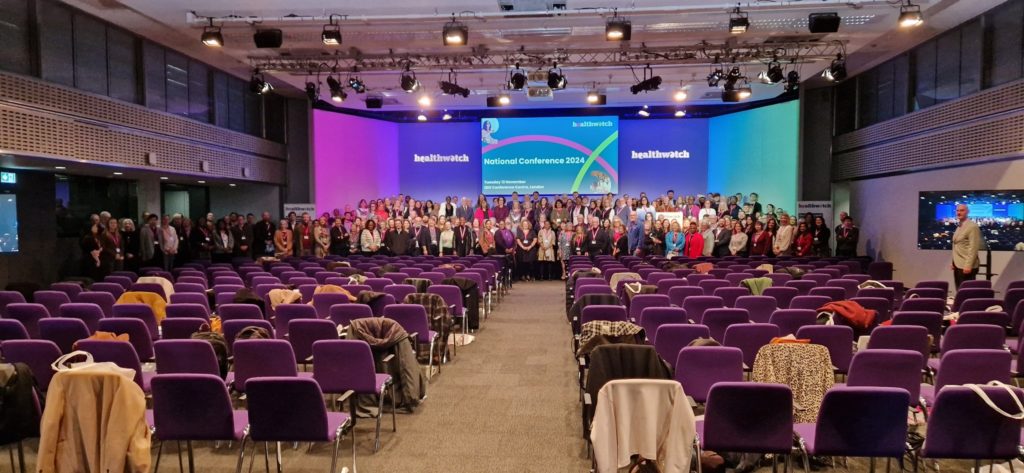
John added: “There was a great turnout from across the country and it was really interesting to chat to other delegates about the different ways that other Healthwatches are run. We also found the sessions which discussed the challenges and future of adult social care very useful.”
Feedback from South Tyneside residents has been included in a national report on dentistry by Healthwatch being published later this week. Read it here.
The operators and the areas they cover are:
The services offered can include domiciliary care, dementia support, respite care, live-in care, end-of-life care, practical support and companionship.
Healthwatch South Tyneside is currently contacting 200 users of home care services – 50 in each zone – on behalf of the borough council to conduct a survey over the phone or arrange its completion online or via post.
Questions range from timekeeping to the quality of care and treatment, time allocated to visits, how easy it is to contact the care agency and details of any issues experienced.
The next phase will see Healthwatch survey staff who deliver the home care services on behalf of the four firms, and ask them to give their feedback on their role and the support they receive to deliver it.
Staff are being asked to complete a short online survey which can be accessed here.
The survey for users of the home care service can be completed here. Please note – we only require feedback on the four named providers.
Healthwatch will analyse the survey findings and produce a report for South Tyneside Council with recommendations based on any common issues raised by service users.
Latest news
21.04.2026
Help others understand health advice and receive a £25 voucher
20.04.2026
Tell us about your experience of hospital discharge
16.04.2026
Athletics legend Steve Cram inspires NHS staff to get active

08.04.2026
Bereaved families invited to take part in new research study

08.04.2026
New mental health support service for LGBTQ+ young people aged 11–25

07.04.2026
Young people waiting up to two years for mental health support
Quick online NHS services

Have your say
Let us know about your recent experience of health and social care services.
Let us know