

21.04.2026
Help others understand health advice and receive a £25 voucher
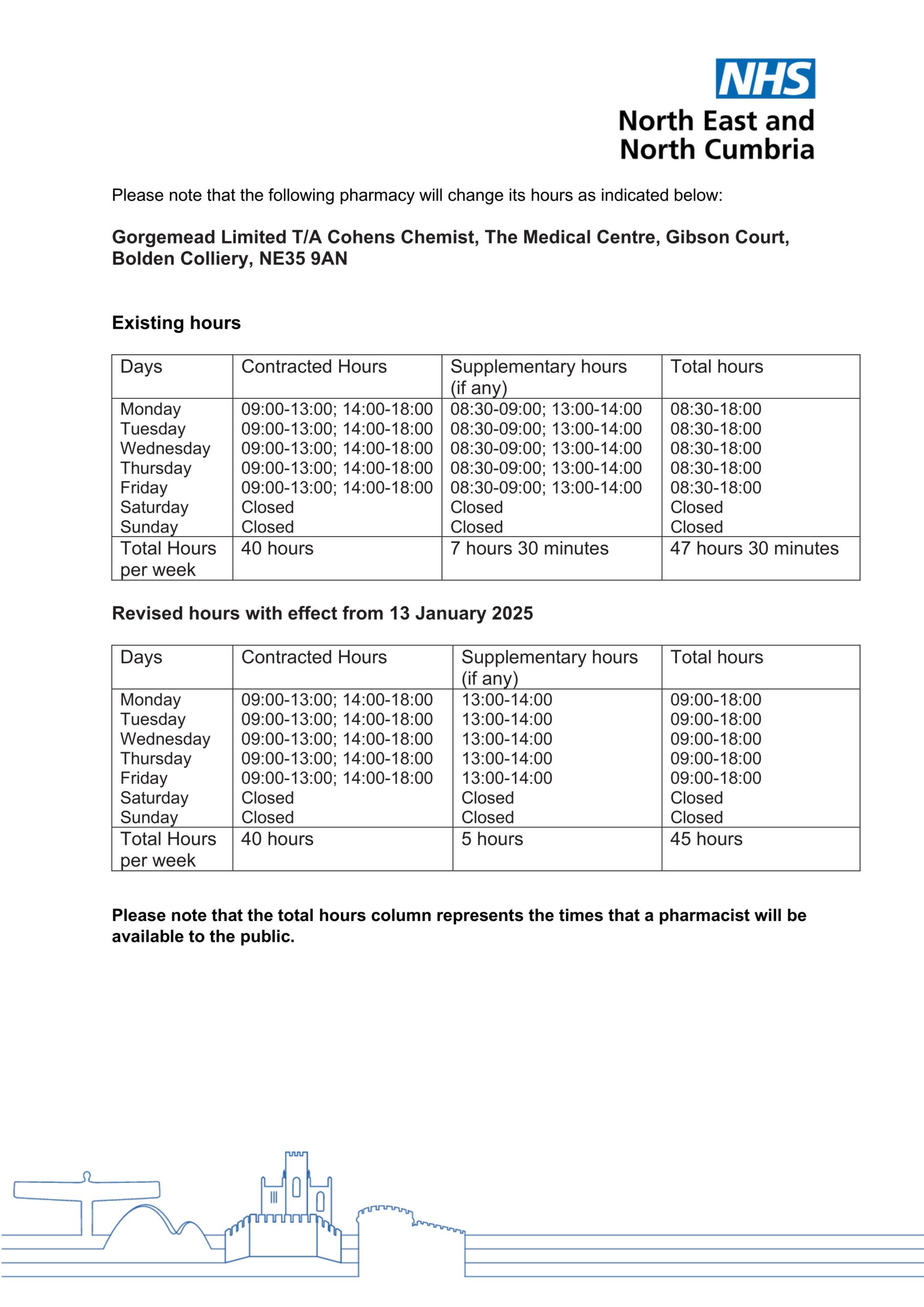
The full new opening hours are:
Monday – 9am to 6pm
Tuesday – 9am to 6pm
Wednesday – 9am to 6pm
Thursday – 9am to 6pm
Friday – 9am to 6pm
Saturday – CLOSED
Sunday – CLOSED
It is still open five hours in addition to its contracted hours, from 1pm to 2pm each weekday.
On Wednesday January 15, it will be at Hebburn Central from 9am to 3pm.
Healthcare professionals will be on hand to offer advice and support to people on a range of lung-related health conditions.
The event aims to bring in the expertise of South Tyneside and Sunderland NHS Foundation Trust’s assessment of breathing clinic (ABC) and acute respiratory assessment service (ARAS).
The Melissa Bus – Mobile Educational Learning Improving Simulation Safety Activities – is a double decker bus that has been designed to deliver healthcare education and training across the North East and North Cumbria.
It calls in at town centres and community centres to provide a ‘pop-in’ service for local people who may need help and advice on medical issues.
There is no need to make an appointment.
During its visit to Hebburn, it will also welcome the local Breathe Well Group Association, Talking Therapies and First Contact Clinical, which is a community interest company based in the borough and supports people with their health and wellbeing.
An NHS spokesman said: “The Melissa Bus is aimed at making it easier for people to seek advice on medical issues and we look forward to people in Hebburn calling in next week.”
Under the upgraded services, patients could receive their diagnosis weeks earlier with NHS chiefs vowing to boost patient experience and end the cycle of people getting stuck waiting between GP referrals and hospital appointments.
As part of the Elective Reform Plan, millions of people will receive quicker diagnosis and treatment to deliver routine care to nine in ten patients within 18 weeks.
The ambitious new blueprint will see more patients receiving a same day service – with a follow up consultation on the same day as their diagnostic test or scan.
Under the reforms, thousands more patients will receive a diagnosis and treatment date within a single day, providing people with peace of mind or a clear way forward for their treatment.
Acceleration of diagnosis times for patients will also come alongside a major expansion of ring-fenced elective capacity in both hospitals and the community – allowing routine care to be protected from winter pressures and future pandemics.
The plan for patients will also ensure that people are as fit and prepared as possible for treatment while they wait for an operation – this will not only boost post op outcomes and speed up recovery, but also reduce the number of on the day cancellations.
Patients waiting for surgery will be offered support to lose weight and stop smoking while they wait, with evidence showing that quitting tobacco four weeks before surgery can substantially reduce the risk of respiratory and wound healing complications by up to a third.
NHS Chief Executive, Amanda Pritchard, said: “While there are too many people waiting unacceptably long for care, NHS staff have made huge progress in bringing down long waits since the pandemic. And backed by government investment, alongside our commitment to continue to reform and innovate, we know that staff can significantly reduce waiting times across the country again.
“With 1 in 9 people in England on a waiting list, we know that there is more we can do to support those who are waiting for crucial tests and procedures.
“By making it easier for people to get timely access to the tests they need alongside direct referrals and same day checks and consultations – this plan will help thousands more people to get a faster diagnosis and quicker treatment or the all clear, so people can get back to living their lives as soon as possible, with peace of mind that they won’t need further treatment.
“The reforms set out in this plan are focused on improving how people access and experience routine care, as much as they are about waiting times – we are determined not to hit the target but miss the point. Simply put, this is a plan with patients at its heart.”
Secretary of State, Wes Streeting, said: “As patients, we’ve all experienced the hoops you have to jump through to get the test or scan you and your GP know you need. It’s a waste of patients’ time, delays diagnoses when every minute matters, and means consultants are forced to tick boxes rather than treat patients.
“The reforms we’re announcing next week will speed up diagnoses and free up NHS staff to treat more patients. Our plan for change will cut waiting lists from a maximum of 18 months to 18 weeks by the end of this Parliament.”
At the heart of the plan is a new gold standard retail offer with compulsory ‘customer service’ training for non-clinical frontline staff like receptionists, and all acute hospitals must have a named patients’ experience champion so those on the waiting list are kept fully up to date and supported with any wait for care.
It comes after hardworking NHS staff have already radically slashed the number of long-waiters since the pandemic, with the number waiting more than a year down by almost half since March 2021.
Healthwatch England Chief Executive Louise Ansari said: “We welcome this new plan’s focus on better waiting experiences, and not just wait times. In our own ‘Patient Vision 2030’ plan last year we had called for a focus on better trained admin staff and expansion of the NHS App, to ensure people got regular and informed updates on when they’d be seen, signposting to local support, and help to manage their condition while they waited for treatment.
“Overall, hospitals must tackle waiting lists in an equitable way – this relies on the NHS knowing who waits the longest, whether children, disabled people or those on low incomes, and taking action to address these inequalities.
“We now hope the urgency on tackling elective waits is extended to other areas such as mental health or GP appointments, within the upcoming 10-year health plan.”
Jacob Lant, Chief Executive of National Voices, said: “Tackling waiting lists is an obvious priority for both patients and the wider public, but with this announcement the government is also making it clear that the overall experience of waiting, and the ability to make meaningful choices about our care is just as important. By getting this right, the NHS can put an end to people feeling lost on lists.
“At the heart of this, we must see the plan deliver routine public scrutiny of who is waiting longer than they should. Current research shows that women, Disabled people and people from ethnic minority backgrounds all wait longer for care, as do people living on lower incomes. The NHS needs to pay specific attention to fixing the equity gap if key commitments around improving healthy life expectancy are to be met.”
President of the Royal College of Obstetricians and Gynaecologists, Dr Ranee Thakar, said: “We are encouraged to see the government’s commitment to improving elective performance, and welcome the ambitious targets set out in this plan. We are all too aware of the impact that the wait for elective care is having on thousands of women in the UK, leaving them living in pain and distress.
“We look forward to the implementation of this plan alongside wider measures we hope to see in the NHS 10-year-plan which we hope will ensure equity of care for all women. This includes ensuring the women’s health workforce across the system has the right support, time and funding to deliver the best care possible, and the widespread establishment of women’s health hubs across the country with the ongoing committed funding to maintain them.”
Adam Brimelow, Director of Communications at NHS Providers, said: “NHS trust leaders are doing everything they can so that patients are seen as quickly as possible. Nobody in the NHS wants people to wait any longer than needed for vital checks, scans, and treatment.
“Health leaders and their teams face huge challenges, but with the backing of this ambitious plan, they’re determined to reduce delays while tackling health inequalities and empowering patients.”
Dr Neil O’Brien, chief medical officer at North East and North Cumbria Integrated Care Board (ICB), said: “Ambulance and A&E teams are under real pressure and are focusing on the patients who need their help the most. Our thanks go to all our staff who are working incredibly hard to ensure patients get the care they need.
“If you’re seriously unwell over the next few days, it’s important that you get help. For anything else, please contact a community pharmacy, 111 online or by phone, an urgent treatment centre or your GP practice when it is open. Patients who come to A&E with minor problems should expect a long wait and may be asked to use a different service.
“We have planned carefully for a busy winter – including special respiratory hubs and Hospital at Home services so more patients can get the care they need without being admitted to hospital. You can really help by using NHS services carefully.”
Claire Jobling, head of operations north for the North East Ambulance Service, said: “We are experiencing additional demand on our service over the holiday period, especially on days when other healthcare providers operate on reduced hours or are closed.
“We are seeing pressure across the whole system, so we are asking that patients only call 999 in a life-threatening emergency. If it’s not a life-threatening emergency, please use 111 online for medical support with illnesses and injuries.
“By doing this, you are supporting the wider NHS and our service to ensure that we have enough resources to care for the poorliest patients at our busiest time of the year.”
For less urgent needs, patients can get help from NHS 111 online, which includes a symptom checker and will re-direct you to a health professional if you need medical attention. You can also phone 111.
Self-care advice is available online at www.nhs.uk, which also includes details of local pharmacy services.
Anyone needing urgent mental health support can get help by calling 111.
Families can also download the Healthier Together app for advice on common childhood illnesses and when to get medical help. Healthier Together is available from the App Store and Google Play.
Survey forms have been distributed to all pharmacies in the borough and the questionnaire can also be completed online here
You can also access the online survey by scanning the QR code on the poster.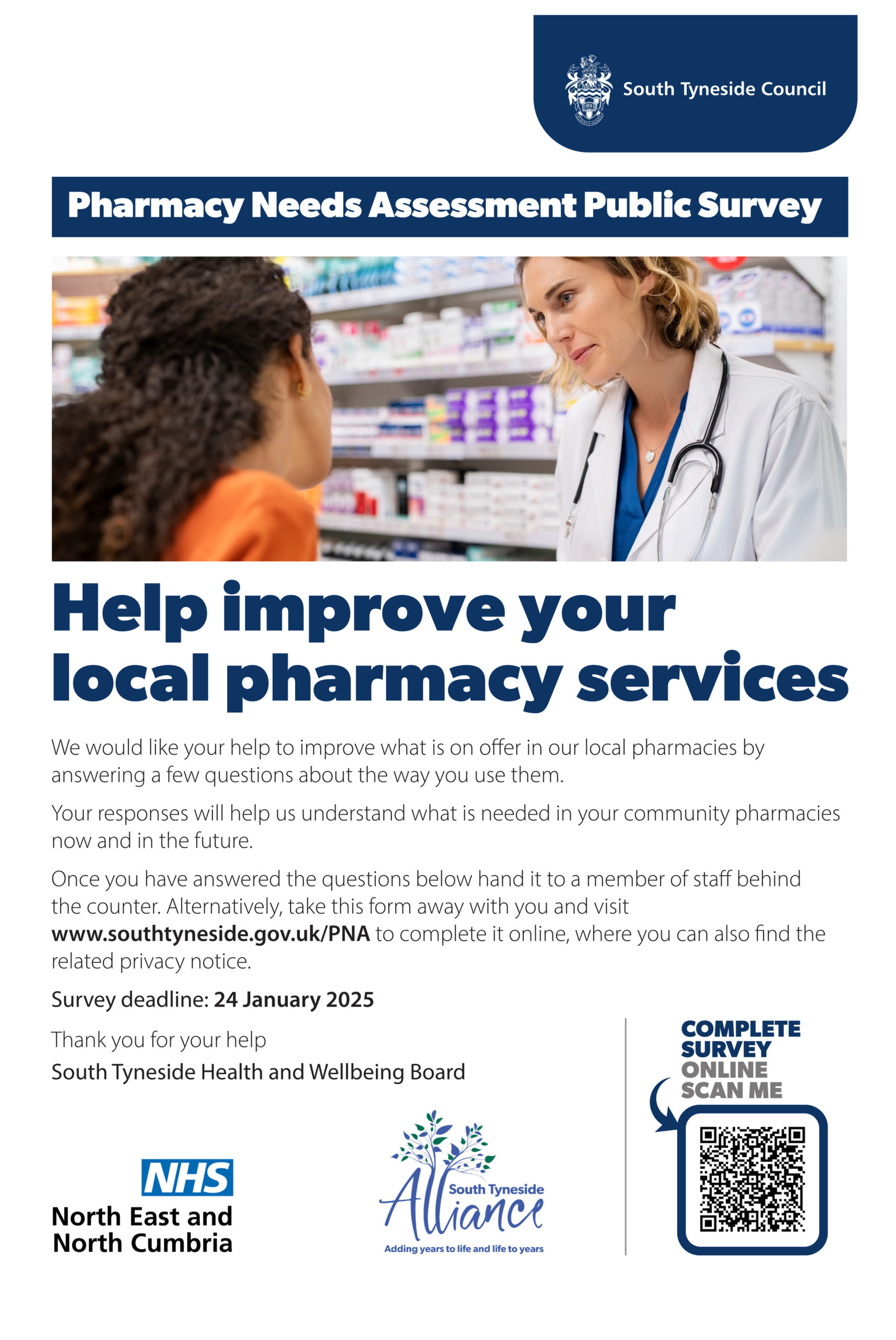
The Pharmaceutical Needs Assessment (PNA) looks at the current provision of pharmacy services across South Tyneside and whether there are any potential gaps in service delivery.
The Health and Social Care Act 2012 transferred the responsibility for developing and updating pharmaceutical needs assessments from Primary Care Trusts (PCTs) to Health & Wellbeing Boards with a requirement to publish the first PNA by 1 April 2015 and at minimum every three subsequent years.
The pharmaceutical needs assessment is used by NHS England in its consideration of applications to join the pharmaceutical list, and by commissioners of community pharmacy enhanced and locally commissioned services to make decisions on how to best meet the needs of the local population.
South Tyneside Health and Wellbeing Board said your responses will help it understand what is needed in community pharmacies now and in the future. For more information visit: https://www.southtyneside.gov.uk/article/8607/Pharmaceutical-Needs-Assessments
The closing date for responses is Friday January 24th.
Norovirus and RSV are also on the rise – norovirus cases are up by 10% from last week and almost two thirds since (64%) last year and 152 children were in hospital with RSV each day, up by over two fifths on the same period last year (107 week ending 10 December 2023).
The “tidal wave” of seasonal illnesses is prompting further “quad-demic” concerns across the NHS with staff pulling out the stops to deliver almost 28 million vaccines so far in convenient places like Christmas markets, football clubs, and supermarkets.
Separate monthly performance data, also published today, shows just how hard NHS staff have been working to deliver care to patients with record numbers of elective treatments and tests and checks in October – showing signs of further improvement in NHS productivity.
Despite busier urgent care services going into winter, the waiting list fell from 7.57m to 7.54m with staff delivering a record 1.67m treatments in a month, up 6% on the same month before the pandemic (1.57m in October 2019). The estimated number of patients waiting in October was 6.34m.
The number of patients waiting longer than 18 weeks (3.1m) is the lowest since June 2023, while the number of waits longer than a year (234,885) is now the lowest since December 2020 and down 46% on the peak of 436,127 in March 2021.
The NHS also delivered:
Pressure on urgent and emergency services did not let up last month, with more ambulance contacts than any other November (1.18m), up 6% on last year (1.1m in Nov 2023). There was also a significant increase in the most serious category 1 incidents, up almost a third last month on the same period pre-pandemic (84,266 vs 63,227).
It was the busiest November on record for A&E staff with a total of 2.31m attendances, 7% higher than last year (2.17m in Nov 2023).
Yet despite the extra demand, teams saw 153,906 more patients within four hours than in November 2023, with performance against the 4-hour target up more than two percentage points on last year (72.1% vs 69.8% in Nov 2023).
Ahead of winter the NHS put in place measures to manage extra demand including upgraded 24-hour co-ordination centres, support for frequent users of A&E services, strengthening same day emergency care and providing more care in the community.
Professor Sir Stephen Powis, NHS National Medical Director, said: “The tidal wave of flu cases and other seasonal viruses hitting hospitals is really concerning for patients and for the NHS – the figures are adding to our ‘quad-demic’ worries.
“While the NHS has plans in place to manage additional demand over the busy winter period, with one week left to book your vaccine, I cannot stress enough the importance of getting booked in to protect yourself against serious illness and to avoid ‘festive flu”.
“Despite the extreme winter pressures early in the year, the figures out today show further improvements towards boosting NHS productivity – not only is the covid backlog reducing but more people than ever before received treatment, a faster cancer diagnosis or a diagnostic check – which shows the truly remarkable efforts from staff.
“We will work with government to bring the waits for care even further with the 10-year health plan next year helping us to transform services for the future, but as the incredibly busy winter continues, I would encourage everyone to remember to use NHS 111 in the first instance and only use A&E and 999 in life-threatening emergencies”.
Health and Social Care Secretary Wes Streeting said: “Since the general election, we have been ramping up to delivering the extra two million appointments a year, ending the strikes, and investing more in the health service.
“As a result, the NHS today is delivering a record number of treatments and waiting lists have begun to fall. There’s a long way to go, but through our Plan for Change we will get patients seen on time again.
“With A&Es facing record demand, we are continuing to encourage people to protect themselves, their family, and the NHS by getting vaccinated before it’s too late.”
Latest news
21.04.2026
Help others understand health advice and receive a £25 voucher

20.04.2026
Tell us about your experience of hospital discharge
16.04.2026
Athletics legend Steve Cram inspires NHS staff to get active

08.04.2026
Bereaved families invited to take part in new research study

08.04.2026
New mental health support service for LGBTQ+ young people aged 11–25

07.04.2026
Young people waiting up to two years for mental health support
Quick online NHS services

Have your say
Let us know about your recent experience of health and social care services.
Let us know