

21.04.2026
Help others understand health advice and receive a £25 voucher
They want to hear about your experience of using the following three services:
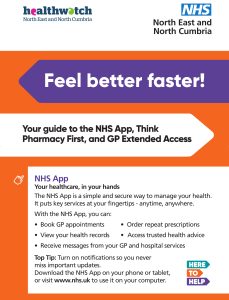
The NHS App is a simple and secure way to manage your health. It puts key services at your fingertips – anytime, anywhere.
With the NHS App, you can:
• Book GP appointments • Order repeat prescriptions
• View your health records • Access trusted health advice
• Receive messages from your GP and hospital services
Your local pharmacist can help with many common health concerns – no appointment needed.
Visit your pharmacy first for:
• Earache, sore throat, colds and flu
• Upset stomach, aches and pains
• Itchy eyes or skin
• Infected insect bites, sinusitis, UTIs, shingles
Pharmacists can also offer free treatment if you qualify, and provide contraception without needing to see a doctor or nurse. They’re experts in everyday health and can even help you stock your medicine cabinet with essentials.
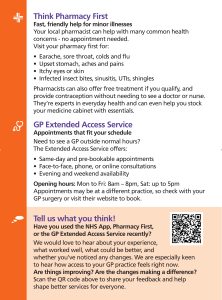
Need to see a GP outside normal hours? The Extended Access Service offers:
• Same-day and pre-bookable appointments
• Face-to-face, phone, or online consultations
• Evening and weekend availability
Opening hours: Mon to Fri: 8am – 8pm, Sat: up to 5pm
Appointments may be at a different practice, so check with your GP surgery or visit their website to book.
As we head into winter, helping people feel better faster is vital. Please take part in the survey and share it widely with your networks, friends, and family via the link below:
https://www.smartsurvey.co.uk/s/Healthwatch-GP-pharmacy-NHS-app-Survey/
Source: https://www.england.nhs.uk/2025/10/nhs-kicks-off-flu-and-covid-jabs-to-winter-proof-vulnerable/
That means patients can be seen faster, as teams triage them quickly through the NHS App and let them book in scans at times that suit them at Community Diagnostic Centres closer to home.
When a patient has an appointment with their GP, they will have the option of being referred to the online hospital for their specialist care. They will then be able to book directly through the NHS App and have the ability to see specialists from around the country online without leaving their home or having to wait longer for a face-to-face appointment.
If they need a scan, test or procedure, they’ll be able to book this in at a time that suits them at Community Diagnostic Centres closer to home. They’ll be able to track their prescriptions and get advice on managing their condition from the comfort of their home.
NHS Online will provide a huge boost to patient waiting times, delivering the equivalent of up to 8.5 million appointments and assessments in its first three years – four times more than an average trust – while enhancing patient choice and control over their care.
Initially the focus will be on a small number of planned treatment areas with the longest waits. Over time this will be expanded to more treatment areas. Treatment areas will only be offered if the NHS knows it is it is clinically safe to do so remotely.
The 10 Year Health Plan will shift the NHS from analogue to digital and this is a bold new way of delivering care while embracing new tech, built on NHS values.
In the first instance, the service will build and scale tried-and-tested innovations already in place across the country such as AI and remote monitoring, with millions of patients already accessing online appointments and using the NHS App to manage their care.
Before NHS Online goes live, the NHS will learn from existing research on patient experience of online care over the last five years and build it into the programme as it develops. The programme is being developed with a commitment to patient partnership in design and delivery.
Connecting patients with specialists across the country means the same high-quality care available to everyone regardless of postcode, helping to reduce variation and inequalities. It will also help to spread out demand, with patients no longer held back by long local waiting lists.
Doctors will have new levels of flexibility, managing their time in a way that works better for them and their patients. NHS England and DHSC will work with clinical staff and their union representatives on how best to deliver this new model of care.
Sir Jim Mackey, NHS chief executive, said: “This is a huge step forward for the NHS and will deliver millions more appointments by the end of the decade, offering a real alternative for patients and more control over their own care.
“Patients who choose to receive their treatment through the online hospital will benefit from us industrialising the latest technology and innovations, while the increased capacity will help to cut demand and slash waiting times.
“The NHS can, must and will move forward to match other sectors in offering digital services that make services as personalised, convenient, and flexible as possible for both staff and patients.”
Jacob Lant, CEO of National Voices, said: “The NHS aims to provide free and universal healthcare, but at the moment there are plenty of people who don’t have easy access to specialist hospital care simply because of where they live in the country.
“The creation of an online hospital has the potential to fix this basic barrier, and by building on the wealth of patient feedback about the roll out of existing digital NHS services, there is a chance to build something genuinely transformational.
“The new service will need to dock in seamlessly with physical services for when people need tests and treatment, and it can do this by making sure patients are fully included in both the design and ongoing evaluation.
“The NHS will need to be live to the risk of digital exclusion, ensuring that people without access to technology or the right skills are supported to get the help they need. But get this right, and it could unlock vital extra capacity that benefits all patients.”
Rachel Power, Chief Executive of The Patient’s Association, said: “NHS Online is a promising step towards enhancing accessible care and shorter waits for digitally confident patients. This model has real potential to cut waiting times and connect patients with expert care more quickly.
“We’re pleased to see patient partnership built into the programme and it will be vital that patients shape the design and delivery of this online hospital. While this initiative will take time to implement properly, it represents an important investment in the NHS’s future capacity alongside high-quality, in-person care.”
Louise Ansari, Chief Executive of Healthwatch England, said: ‘We welcome this model which offers the prospect of patient referrals being triaged more quickly and some patients getting scans and diagnostic tests sooner.
‘It is also welcome that government has committed to working with Healthwatch and patient groups on its delivery.
‘It will be key, for example, that all patients have an equal opportunity to benefit, not just those who are tech-savvy. The public will need clear communication about how to benefit and access from this scheme – including support, if required, to sign up to and use the NHS App. And digitally excluded people will need reassurances that their local physical hospital remains a good option for their care.’
Dr Jeanette Dickson, Chair of the Academy of Medical Royal Colleges said: “This is a novel and potentially game changing way of improving equity and speed of access to NHS services, which would reduce health inequalities.
“Obviously, we need to make sure that those who aren’t digitally enabled are not penalised in any way, but if this approach can be delivered safely and effectively, freeing up capacity in bricks and mortar hospitals at the same time then it could potentially be a really good thing.’
Rosie Beacon, Re:State Head of Health, said: “Re:State welcomes the announcement to open an entirely virtual hospital, NHS Online. This is exactly the sort of game-changing reform the NHS needs.
“Virtual hospitals will mean shorter waits, quicker treatment and smarter spending and will help slash the elective backlog. NHS Online serves to reinforce the NHS’s long held legacy as a world leader in care innovation.”
Source NHS England: https://www.england.nhs.uk/2025/09/new-nhs-online-hospital-to-give-patients-more-control-over-their-care/
Patients must be informed of the outcome of their query within one working day, and practices may no longer ask patients to call back the next day.
From October 1, practices must not close online consultations during core hours for ‘non-urgent appointment requests, medication queries and administrative requests’.
The charter also outlines patient responsibilities, encouraging the use of the NHS App, 111 and community pharmacy when appropriate. It sets out patients’ rights to register with a GP practice and how to raise concerns. Practices will be required to share a link to the charter on their website.
The intention is to improve access, reduce inequities and restore trust in the NHS’s ‘front door’. The changes form part of an additional £889m investment in general practice under the 2025/26 contract – the largest in over a decade.
The 8am scramble for same-day GP appointments, typically via congested phone lines, has become symbolic of wider NHS pressures. It is a result of GP practices capping appointments subject to staffing levels and closing online consultations after a self-set time or quota – often based on first-come-first-served systems and limited triage.
The causes are partly due to constrained capacity: GP numbers have declined relative to population growth since 2015. But the causes of the 8am scramble also reflect broader system failures, including missed elective and A&E targets. This strain is also compounded by the COVID-19 pandemic, increasing complexity of medical care and the demands of a growing, ageing population.
You and Your General Practice (YYGP) describes what practices and patients can expect of each other and has been developed to help patients get the best from their GP team. It also sets out how patients and or their representatives can provide feedback or raise concerns about their GP practice. All GP practices will have a link to the YYGP information on their website from October 1 on their practice website home page.
If you want to give feedback or raise a concern you can ask to speak to your practice manager. If preferred, you can contact Healthwatch South Tyneside at info@healthwatchsouthtyneside.co.uk or call 0191 4897952 or leave your feedback with North East and North Cumbria Integrated Care Board here: https://app.onlinesurveys.jisc.ac.uk/s/nencicb/tell-us-what-you-think
Thousands of community pharmacies, including those in local supermarkets and on the high street, will kick off walk-in and booked flu vaccine appointments from this Wednesday (October 1) for two and three year olds and all other eligible adults, in a bid to make it as convenient as possible for people to get protected.
This is just one of the ways the NHS is helping to winter-proof its services and improve access to vaccinations for people, and comes alongside some areas with low uptake delivering vaccines in nurseries and hosting mobile vaccination buses to help reach more vulnerable people of all ages.
The flu vaccine is typically given to young children as a quick, painless nasal spray.
Starting flu vaccinations across autumn will ensure those most at risk are protected when flu season peaks, typically in December and January, when more people gather indoors and viruses can spread.
England’s top nurse is urging parents to come forward as soon as possible given vaccination is the best way to protect their children from getting sick with flu and prevent hospitalisations from the virus this winter.
Duncan Burton, chief nursing officer for England, said: “For busy families, it can be hard to fit everything in, but parents will now be able to pop into a pharmacy in their local high street or supermarket to get their little ones protected ahead of winter, when bugs tend to circulate.
“Flu can make young children and toddlers seriously unwell, and vaccination is the best way to shield them, so we’re making it easier than ever before to get the vaccine closer to home.
“I urge all parents to bring their children forward – the vaccine, which is typically given to toddlers as a quick, painless spray up the nose is safe, effective, and proven to help prevent hospitalisations from flu – so please check your local pharmacy, book an appointment online or speak to your GP practice”.
The expansion to pharmacies is also a key example of how the NHS is shifting healthcare from sickness to prevention as part of the 10 year health plan, by improving access to vaccinations and keeping people out of hospital.
Since the start of September, vaccination teams have been rolling out flu vaccines to pregnant women and children through GP practices, maternity services and via schools.
From October 1, flu vaccines will start being rolled out to all eligible people. Over 12 million invitations are being sent via email this week, with further invites set to go across the month via the NHS App, text and letter.
Those eligible to not need to wait for an invitation to book – they can book an appointment now to get their flu vaccine at a pharmacy via the NHS App, or GP practice, online at www.nhs.uk/bookflu or via 119. From Wednesday they can use the pharmacy finder to find walk-in appointments.
Over 75s and those that are immunosuppressed can book their COVID-19 vaccine directly with their GP practice or at a pharmacy via the NHS app, online at www.nhs.uk/bookcovid or via 119.
Last winter, there were more than 300,000 hospital bed days taken up by patients with flu – almost double the previous winter (175,062 in 2023-24) and close to 50% higher than the year before (216,120 in 2022-23).
COVID-19 vaccinations are available to adults aged 75 and over, older adult care home residents, and people who are immunosuppressed.
Flu vaccines are available for everyone aged 65 and over, under 65s in clinical risk groups, care home residents and carers, close contacts of those who are immunosuppressed, frontline social care workers, and health and social care staff, as well as children and pregnant women.
Health Minister Ashley Dalton said: “With winter approaching and flu season just around the corner, this is a crucial step forward in protecting our youngest children when they need it most. By extending vaccination services to high street pharmacies for the first time, we’re making it easier than ever for families to get vital protection closer to home before the cold months hit.
“Last winter alone, flu accounted for more than 300,000 hospital bed days – and we cannot afford a repeat of that on our NHS this winter. It is exactly the kind of preventative healthcare approach this government is committed to delivering through our 10 Year Health Plan – protecting people before they get sick, especially during the challenging winter months ahead”.
Last year, the NHS delivered more than 18.5 million flu vaccinations to adults and children – including over half a million to two and three-year-olds (18,520,146 in total and 524,648 to children aged 2-3 across autumn/winter 2024/25).
The UK Health Security Agency (UKHSA) found that the flu vaccine is estimated to have prevented around 96,000 to 120,200 people from being hospitalised in England last winter in 2024-25.
Dr Suzanna McDonald, Flu Vaccination Programme Lead at the UKHSA, said: “It’s great to see pharmacies supporting parents of 2- and 3-year-olds and offering greater flexibility to help improve access to flu vaccines ahead of this winter. Flu can be a very nasty illness for anyone and every year thousands of children do end up in hospital with flu. Nobody wants this for their child, so do what is best and ensure they get their flu vaccine on time to give them this important protection”.
The health service will also be ensuring vital medication like Tamiflu is easily available for those at high risk of developing complications from flu.
Janet Morrison, Chief Executive of Community Pharmacy England, said: “Community pharmacies are pleased to now be able to offer NHS flu vaccination to two and three-year-olds, as well as adults. With a network of pharmacies in key locations where people live, work and shop, this new service should make it easier for parents to get their children protected. Increasing vaccination rates will help keep flu at bay in our communities this winter.”
Source NHS England: https://www.england.nhs.uk/2025/09/nhs-makes-it-easier-than-ever-to-protect-toddlers-against-flu/
You can also read updates from the STS Charity and real-life stories from some of its patients and the work the trust’s teams do every day.
Download by clicking on this image of the front cover:

Latest news
21.04.2026
Help others understand health advice and receive a £25 voucher
20.04.2026
Tell us about your experience of hospital discharge
16.04.2026
Athletics legend Steve Cram inspires NHS staff to get active

08.04.2026
Bereaved families invited to take part in new research study

08.04.2026
New mental health support service for LGBTQ+ young people aged 11–25

07.04.2026
Young people waiting up to two years for mental health support
Quick online NHS services

Have your say
Let us know about your recent experience of health and social care services.
Let us know