
23.07.2026
NHS staff celebrate ‘incredibly exciting’ new home as Sunderland Specialist Eye Hospital fully opens
Sunderland Specialist Eye Hospital provides a new home for world-class eye services, which will serve communities across the North East and North Cumbria for generations to come.
It is a purpose-built facility that will help meet growing demand for specialist ophthalmology care, building on Sunderland’s proud eye care heritage which stretches back almost 200 years.
The move represents the culmination of years of planning and investment and creates a modern new home for one of the country’s leading eye care services.
Departments have transferred to the new hospital in phases over recent weeks, with every service now fully operational from the Riverside Sunderland site. To celebrate, staff gathered this week to mark being together in their new home for the first time.
Ajay Kotagiri, Clinical Director for the trust’s eye services, said: “This is an incredibly exciting moment for our patients, our staff and everyone connected with our eye care services.
“Sunderland Eye Infirmary has cared for generations of people. It will always hold a special place in our history. However, Sunderland Specialist Eye Hospital gives us a modern environment equipped with the latest technology. It will allow us to deliver outstanding care now and for many years to come.
“The new hospital has been designed to improve the experience of patients and families while giving our teams the facilities they need to provide the very best treatment. So much work has gone into getting us ready to this day and I’m so grateful for the work of all our teams which have got us here.”

Trust’s Chief Executive Ken Bremner MBE said: “It is a tremendous achievement by everyone involved in getting us to this day. I want to thank everyone who has played a part in planning and building this fantastic facility.
“It is a very proud moment in our history and will see us offer eye care for Sunderland and our region for many decades to come.”
Sunderland Specialist Eye Hospital’s 24/7 Eye Emergency Department was the first to open and welcomed patients from Saturday July 11.
Among those who have attended the Eye Emergency Department since it opened is four-year-old Jude Petrie, who visited with his mother Natasha Phelps. 
Jude (pictured) experienced a rash around one of his eyes following a procedure to treat a squint in both eyes at Sunderland Eye Infirmary late last month. They visited on its first Sunday, before returning a couple of days later for further care.
Natasha, 30, from Chester-le-Street said: “It’s lovely, it’s so new and Jude knows he was one of its first patients. Everyone has been really good with him and made sure he’s been looked after.
“It’s easier to get to, it’s more central, it’s got the park next to it and we’ve been to the café. I think it’ll make a big difference.”

The hospital is the region’s first all-electric powered hospital and has been constructed with a series of environmental features, including a green roof on its energy centre, air source heat pumps and solar panels. It has electric vehicle charging points and disabled spaces in its 90-space car park, which is set aside for patient use.
It is also paper-light, as electronic records are used by the teams, and there is cycle storage for staff.
The hospital also boasts a coffee shop and café, which are run by the RVS charity, a baby feeding space, a quiet/faith room and it is the base of its Eye Care Liaison Officers (ECLOs), which is a support service run by the RNIB.
The new hospital was built in partnership with Sunderland City Council and built by Kier Construction.
The Trust’s dedicated charity, STS Charity, ran the Vision Appeal, raising funds for enhanced equipment, to improve the patient experience initiatives and staff wellbeing beyond standard NHS provision.
More about the hospital can be found via this page: Sunderland Specialist Eye Hospital
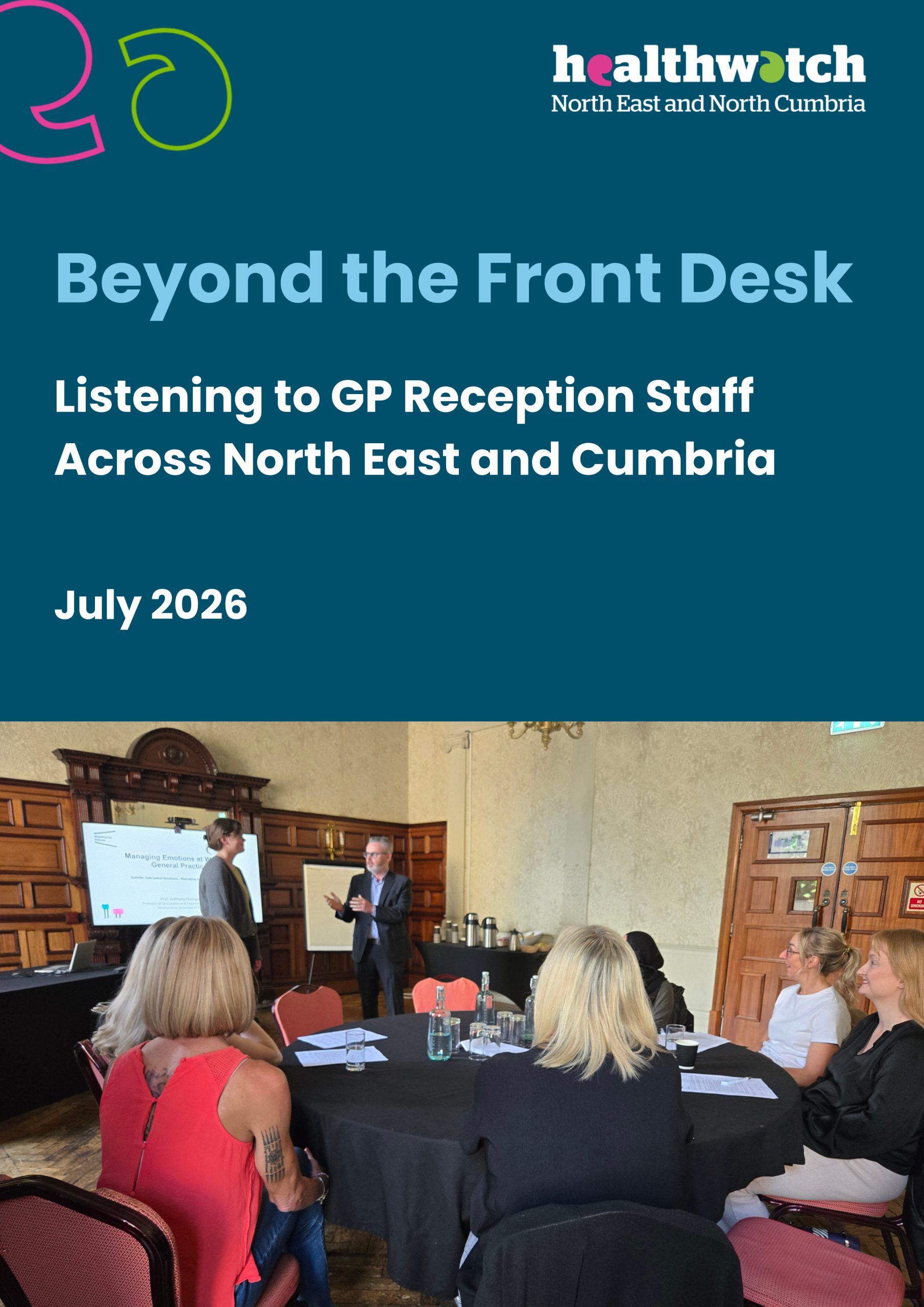
Drawing on established and trusted relationships built over many years with GP practices, communities and system partners, Healthwatch was able to engage reception staff from across the region and create a supportive environment where people felt comfortable sharing their experiences openly and honestly.
The workshop was delivered by Professor Anthony Montgomery, Professor of Occupational and Organisational Psychology, and facilitated by Healthwatch colleagues from across the NENC network.
Developed in partnership with Workforce Voices and the NIHR Partnership for Workforce Sustainability, the event combined the research expertise of the NIHR team with Healthwatch’s experience in engagement, participation and creating trusted spaces where people feel heard.
The event was a huge success and the feedback from attendees was incredibly positive, with reception staff speaking openly and honestly about the realities of their role.
Download the report here.
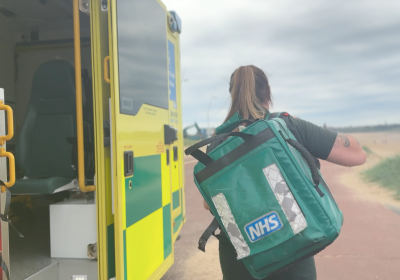
The campaign aims to raise awareness of seasonal risks and educate children, teenagers and young people about making safer choices.
Every summer, ambulance crews respond to preventable emergencies linked to hot weather, open water and outdoor activities, including cycling and the use of scooters and other wheeled transport.
New figures highlight the scale of demand across the North East between June and September 2025. During that period, NEAS responded to:
Stu Holliday, Strategic Head of EPRR (Emergency Preparedness, Resilience and Response), said: “Every summer, we see an increase in incidents linked to hot weather, open water and outdoor activities. Many of the emergencies we attend could be prevented through greater awareness and a few simple precautions.
“The impact of summer weather is already being felt across our region. In June 2026 alone, NEAS responded to 329 bike-related incidents, 205 heat-related incidents and four water-related incidents.
“We work closely with our partners HM Coastguard, RNLI, fire and rescue services, police, mountain rescue teams, Great North Air Ambulance Service (GNAAS) and local hospital trusts to keep communities safe across the region, but it’s important that the public consider what they can do too.
“That’s why we’re launching this campaign, to help people make informed choices, stay safe and enjoy the summer. A key focus is helping young people understand the risks and make safer choices that could prevent serious injuries and save lives.”
High temperatures can cause heat exhaustion, dehydration and worsening of existing health conditions. Children, older people and those with long-term illnesses can be particularly vulnerable.
Stephanie McIntyre, paramedic, said: “During hot weather, we regularly attend people who are unwell due to heat exhaustion and dehydration, and many are surprised by how quickly it can happen.
“Simple steps such as drinking plenty of water, taking breaks in the shade and avoiding activity during the hottest part of the day can make a real difference.
“It’s also important to recognise the signs of heat stroke, which is a life-threatening emergency. If someone becomes confused, collapses, or has a very high temperature, call 999 immediately.”
Barisuka Johnson, clinician, added: “Hot weather can affect anyone, but older people, young children and those with long-term health conditions are often at greater risk.
“Having essentials such as water, sunscreen and basic first aid supplies available at home and in your car can help you deal with minor issues before they become more serious.
“It’s also important to use the right service when you need care. For urgent advice, NHS 111 can help, while 999 should only be used in a life-threatening emergency.”
Water safety is a key focus of the campaign as more people visit beaches, rivers and lakes during warm weather. While open water can appear safe, it often remains dangerously cold, increasing the risk of cold-water shock, drowning and people finding themselves in difficulty.
HART Team Leader Esme Bellerby said: “On warm days, we see more incidents involving open water. Rivers, lakes and the sea can look safe, but they’re often much colder and more dangerous than people realise.
“Sadly, we continue to see tragic incidents across the country, particularly involving younger people getting into difficulty in the water. That’s why it’s so important that we educate children and teenagers about the risks and help them understand how quickly things can go wrong.
“Think carefully before entering open water, look out for one another and make safer choices and remember to float to live. If someone is in difficulty, call 999 and ask for the Coastguard.”
Road and bike safety is another key focus, with increased numbers of cyclists, e-bike users, scooter riders and motorcyclists on the roads during summer.
Specialist paramedic, Thomas Mortillaro said: “During the summer, we see more serious injuries involving bikes, e-bikes and other wheeled activities. Too often, traumatic head injuries could have been reduced by wearing a helmet.
“What stays with me is the domino effect these incidents can have. Life-changing injuries don’t just affect the patient – they have a huge impact on families, friends and the emergency responders involved.
“Whether you’re on a bike or behind the wheel, making safe choices on the road and looking out for others can make all the difference.”
The campaign encourages people to make safer choices, look after themselves and those around them, and reduce the risk of needing emergency care.
The service is urging families to find out more about summer safety advice on the NEAS website: NEAS Summer Safety Advice
Top tips include:
North East Ambulance Service NHS Foundation Trust (NEAS) covers 3,230 square miles across the North East region. It employs more than 3,600 staff and serves a population of 2.7 million people by handling all NHS 111 and 999 calls for the region, operating patient transport and ambulance response services, delivering training for communities and commercial audiences and providing medical support cover at events.
NEAS has 67 properties including 61 stations, three emergency operations centres, and three training and education centres. It operates around 147 double crewed vehicles and 173 patient transport vehicles as well as 56 emergency response cars, used by specialist paramedics, advanced practitioners and officers, and a fleet of support vehicles including driver training and specialist vehicles for the Hazardous Area Response Team.
In 2025/26, the service answered more than 1.475m emergency 999 and NHS 111 calls, with more than 298,000 patients taken to hospital, more than 56,000 patients treated and discharged over the phone and more than 143,800 patients treated and discharged at home. It responded to more than 40,444 C1 serious and life-threatening incidents in an average time of 6 minutes 17 seconds.
Sir Jim’s warning comes as the NHS today launched a new campaign to remind staff what constitutes unlawful access, the potential impacts on patients and what the consequences could be for their career.
The campaign follows several incidents of staff being dismissed from their posts after accessing the medical records of victims of high-profile crimes, including the Nottingham attacks.
NHS England has today published new guidance for all NHS organisations on preventing and monitoring unauthorised access, as well as their responsibilities in investigating and reporting it.
The guidance sets out the different types of unlawful access, and makes clear that where it occurs, employers may report it to the Information Commissioner’s Office (ICO) and police – both of whom have the power to pursue a criminal prosecution – as well as to professional regulators, which can end a career.
It also provides guidance for how monitoring and regular audits can be conducted depending on the IT systems organisations have in place. For example, some newer electronic patient record systems may be able to identify unlawful access in ‘real’ time, with the capability to set up alert ‘flags’ to identify suspicious activity.
Employers are being asked to ensure appropriate technical controls are in place for their organisation to protect people’s information without stopping staff from doing their jobs – such as ‘role-based’ controls – and minimising access to very sensitive information to only those that must see it to fulfil their role, and multi-factor authentication.
NHS England’s new campaign launches today with screensavers on staff computers and posters around NHS organisations urging staff to protect patients’ privacy, respect confidentiality, and not to ‘let curiosity kill your career.’
Sir Jim Mackey, NHS Chief Executive, said: “Patients must be able to trust that their personal information is kept confidential by the NHS – any instance of staff looking at records without a valid reason is wholly unacceptable, a disgraceful breach of patients’ trust and against the law.
“While the majority of NHS staff handle patient information responsibly and professionally every day, it’s been incredibly worrying that a small number have chosen to undermine the trust that patients place in them and caused such additional distress for families who deserved so much better from us.
“Anyone considering accessing records for personal reasons or out of curiosity should be in no doubt they could be putting their career at risk, and may face disciplinary action, dismissal, referral to the regulator or even time in prison.
“We will not tolerate a culture of curiosity when it comes to patient confidentiality – there is no place in the NHS for those who misuse patient information and together we will take firm action to prevent and monitor unlawful access, and to act decisively when that occurs.”
Paul Arnold, ICO Chief Executive Officer, said: “When people seek medical care, they share some of their most sensitive personal information in the trust that it will be kept safe. Unauthorised access to those records is not just a breach of data protection law — it is a betrayal of that trust, with real and lasting consequences for patients and their families.
“Having the ability to view a record is not the same as having a legitimate need to do so. Every member of staff has a personal responsibility to respect that boundary, and every patient has a right to expect that they will. Staff who breach that trust face serious consequences: loss of employment, removal of professional accreditation and criminal prosecution.”
They will share simple information about kidney health and help people find out how to get checked.
Chronic kidney disease, also called CKD, is a long-term condition that affects how well the kidneys work. Around 1 in 10 people have CKD. Many people do not know they have it because it often has no symptoms at first. Finding kidney disease early can help people get the support and treatment they need.
You will help at outreach events in local communities. This may include:
There may also be opportunities to raise awareness within your own community outside of organised events.
A kidney health check looks for common signs of kidney disease. This may include:
Healthcare professionals can also apply. If you are a healthcare professional, you may also:
Volunteers will get free training from Kidney Research UK. Training will last:
You can get a £100 gift voucher after you finish training and take part in an event. You can also claim back:
You can apply if you are:
You do not need clinical experience to apply. You must be able to join events in South Tyneside, Sunderland or South Tees.
Interested in helping your community? Fill in the expression of interest form or get in touch.
This will welcome low-risk patients who have glaucoma or retinal conditions such as diabetes and macular degeneration, a common eye condition that can affect vision as people get older.
It will offer them their regular eye scans and photos. These are used to check on the health of the eyes. They can then be called in for further appointments and treatment if needed.
The imaging service, currently running at Sunderland Eye Infirmary, has seen around 8,000 patients in its first year. The move to a new dedicated Eye Imaging Hub in a community location now means the NHS will be able to see more patients, meaning people will get faster access to care.
Jill O’Brien is the Acting Head of Ophthalmic Photography for the Trust and is part of the team setting up the hub.
She said: “The Beacon of Light is a fantastic building and great location for this community service. Patients will be able to join in other activities while they are there, catch a cuppa at its café and take advantage of two hours of free parking or use the nearby transport links.
“The team is really excited. We know it’ll make it a much better experience for the people we see. We’re looking forward to having our own dedicated space. We can’t wait to be able to welcome people to the hub.
“Our Trust and the Beacon of Light both want to help people be healthier, so it’s been so great to work together to set this up.”
The Eye Imaging Hub will have its own welcome desk and be staffed by a team of four ophthalmic imaging technicians.
When glaucoma patients visit, they get three scans of their eyes which look at their structure and for any loss of vision. They will also have a field test to check their peripheral vision. They fill out a questionnaire on how well they can see and any drops they use.
Those with retinal conditions have a scan on their eyes and a colour photograph is also taken. These patients often need eye drops to dilate their pupils and this means they cannot drive afterwards. The new location will make it easier for them to use public transport or be dropped off.
All scans and images are reviewed by a consultant, and patients will get an update within around four weeks of their appointment. If the eye team spot any immediate issues of concern during imaging, they will make sure patients are seen quickly by colleagues at Sunderland Specialist Eye Hospital.
Work is ongoing to kit out the new space, which is on the ground floor and set to open later this month. Patients should check their appointment letters, for details of where to go.
The move to the Beacon supports the NHS’s drive to be fit for the future and base more services in the community, prevent illness rather than just treat it and use digital tools. These are all part of its 10 Year Health Plan. Today is the one year anniversary of its launch.
The new NHS Eye Imaging Hub will also play a pivotal role in helping to identify ill health by working closely with The Northern Ophthalmic Research and Innovation (NORI) Institute.
Hosted by the University of Sunderland, NORI is a pioneering new research programme that will securely link routine eye images with other community and NHS data, to help spot early signs of other health conditions such as diabetes, dementia, heart disease and stroke.
Ajay Kotagiri is the Clinical Director of Ophthalmology for the Trust and shared his thanks with the Beacon of Light team for their work to turn the plan into a reality.
He said: “When our new Eye Imaging Hub opens, it will be a pivotal moment in way we deliver eye care and, most importantly, prevent eye ill health.
“For so many eye conditions it is important that we monitor them closely so that we keep peoples’ eyesight as good as it can be, for as long as possible.
“By opening an imaging hub in the community, we will be able to see so many more patients which means faster access to care and greater peace of mind for everyone.”
The new Eye Imaging Hub comes at an exciting time for eye services in the city with the new Sunderland Specialist Eye Hospital also set to open later this month. For more details visit: Sunderland Specialist Eye Hospital
The Beacon of Light is run by Foundation of Light, which is the official charity of Sunderland AFC.
Jamie Wright, Chief Operating Officer at Foundation of Light, added: “The Beacon of Light was created to bring together services that help people live healthier, happier lives, so we’re delighted to welcome the new NHS Eye Screening Hub as part of our growing health hub offer.
“By bringing specialist screening into a trusted community setting, we’re making essential healthcare more accessible for local people, while strengthening our shared ambition to improve health outcomes and partnership working.”
Find out more: http://www.stsft.nhs.uk/neweyehospital
Latest news
23.07.2026
NHS staff celebrate ‘incredibly exciting’ new home as Sunderland Specialist Eye Hospital fully opens

17.07.2026
Beyond the front desk: hearing from GP reception staff
14.07.2026
North East Ambulance Service urges public to stay safe this summer

08.07.2026
NHS warns ‘snooping’ staff face sack or prison for inappropriate access of patient data

07.07.2026
Volunteers to help people learn about kidney health sought

07.07.2026
New community hub for eye checks gets ready for kick off
Quick online NHS services

Have your say
Let us know about your recent experience of health and social care services.
Let us know